To create a more consistent greenhouse, automate key environmental controls like lighting and humidity systems. Use programmable lights to simulate natural sunlight cycles and sensors to adjust light levels, preventing overexposure or deficiencies. Implement automated humidifiers and dehumidifiers to maintain ideal moisture, reducing risks of mold and stress. Combining these systems with temperature regulation and ventilation creates a stable environment. Keep exploring how integrating these controls can help you achieve healthier, higher-yielding plants year-round.

Get garden gear delivered free — and shop member deals
- Fast, free delivery on millions of items
- Access to Prime Big Deal Days deals on October 6–7
- Prime Video, Amazon Music and more included
Key Takeaways
- Implement automated lighting systems that adjust based on time, sensors, and weather for consistent light exposure.
- Use continuous humidity monitoring and automated humidifiers/dehumidifiers to maintain optimal moisture levels.
- Integrate environmental controls to synchronize lighting, humidity, temperature, and ventilation for stable conditions.
- Utilize programmable systems that adapt to seasonal changes, reducing manual adjustments and ensuring uniform environments.
- Regularly monitor and fine-tune automation settings to optimize plant growth and prevent environmental stress.
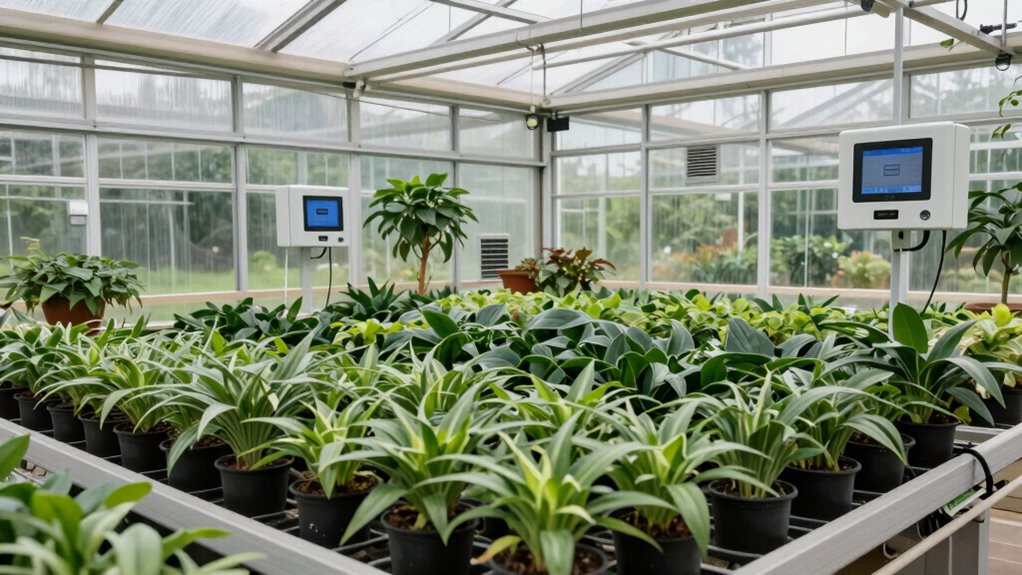
Have you ever wondered how to keep your greenhouse thriving year-round? The key lies in implementing better controls that optimize the environment for your plants. Two essential aspects to focus on are lighting automation and humidity regulation. These controls help you create a consistent climate, reducing stress on your plants and improving yields. With the right systems in place, you won’t have to manually adjust everything daily, giving you more time to focus on other gardening tasks.
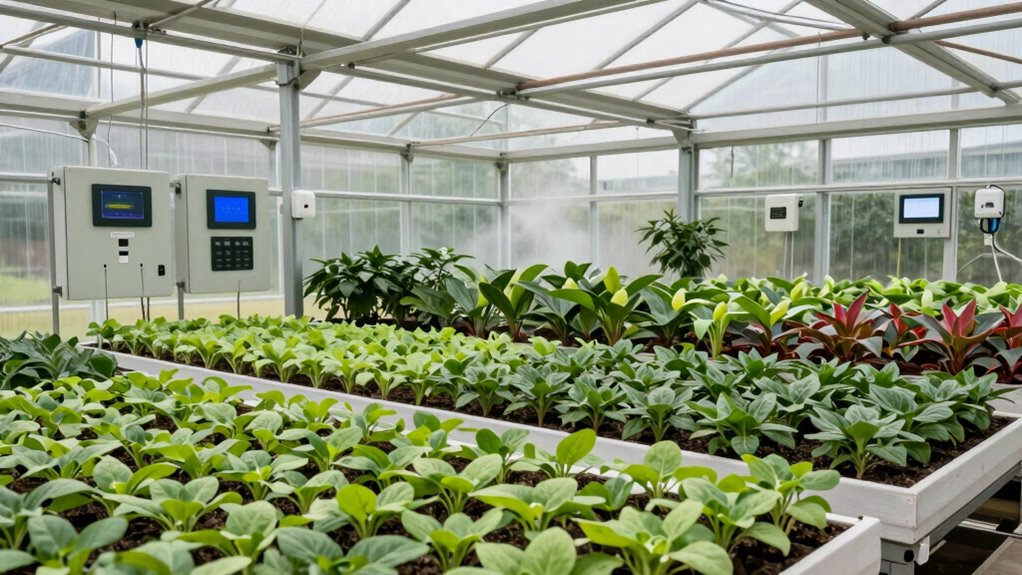
Lighting automation is a game-changer. It ensures your plants get the right amount of light at the right times, regardless of weather changes or daylight hours. By setting up automated lighting systems, you can simulate natural sunlight cycles, promoting healthy growth and flowering. These systems can be programmed to turn on or off based on time, light sensors, or even weather conditions. That way, you won’t need to worry about overexposure or insufficient light, which can hinder plant development. Automated lighting also helps maintain consistency across different sections of your greenhouse, so every plant receives ideal light, improving overall health and productivity.
Automated lighting ensures optimal light cycles, boosting plant health and productivity regardless of weather or daylight changes.
Humidity regulation is equally essential for creating a stable environment. Too much humidity can lead to mold, mildew, and disease, while too little can cause plants to wilt or stunt their growth. Installing humidifiers and dehumidifiers that work automatically allows you to keep humidity levels within a narrow, perfect range. Sensors placed throughout your greenhouse monitor moisture levels constantly, triggering these devices to add or remove moisture as needed. This automated process ensures your plants experience minimal environmental stress, supporting vigorous growth and reducing the risk of pests and diseases that thrive in unstable conditions. Understanding the importance of environmental control systems can help you make better decisions for maintaining optimal conditions. Additionally, integrating automated environmental controls can further streamline your greenhouse management, making it easier to sustain ideal growing conditions.
When you combine lighting automation with precise humidity regulation, you greatly enhance the consistency of your greenhouse environment. These controls work together to create a stable setting that adapts to seasonal changes and weather fluctuations. As a result, your plants grow stronger, healthier, and more predictable, which is especially important if you’re aiming for high yields or quality produce. Plus, these systems can often be integrated with other environmental controls, like temperature regulation and ventilation, giving you a complete, automated solution.
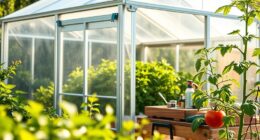
automated greenhouse lighting system
As an affiliate, we earn on qualifying purchases.
As an affiliate, we earn on qualifying purchases.
Frequently Asked Questions
What Are the Best Sensors for Greenhouse Climate Control?
You should choose high-quality sensors like thermocouples, hygrometers, and CO2 sensors for climate control. Place them strategically—near vents, plant canopy, and ambient areas—to guarantee accurate readings. Proper sensor placement improves data accuracy, which is essential for precise adjustments to temperature, humidity, and CO2 levels. Regular calibration and maintenance keep sensors reliable, helping you maintain a consistent environment that promotes healthy plant growth.
How Often Should I Calibrate Greenhouse Control Systems?
Your greenhouse control systems are the backbone of your success, so don’t let sensor inaccuracies cause chaos! You should calibrate sensors at least once every three to six months, depending on usage and environmental conditions. Regular calibration ensures sensor accuracy remains sharp, preventing costly errors. Keep a schedule, check for drift, and trust your system to maintain ideal conditions—think of calibration as your secret weapon against unpredictable climate swings!
Can Automation Reduce Energy Costs in Greenhouses?
Yes, automation can considerably reduce energy costs in greenhouses. By precisely controlling temperature, humidity, and lighting, automation benefits include optimized energy use and minimized waste. You’ll experience energy savings as systems adapt in real-time to environmental conditions, reducing unnecessary heating, cooling, or lighting. This not only lowers your utility bills but also promotes a more sustainable operation, making your greenhouse more efficient and environmentally friendly.
What Maintenance Is Required for Control Equipment?
You’ll need to regularly check sensor accuracy and guarantee equipment durability. Ironically, the most overlooked maintenance involves calibrating sensors and inspecting for wear and tear, which keeps control equipment running smoothly. Neglecting these tasks can lead to inaccurate readings or system failures. So, stay proactive—clean sensors, replace worn parts, and test system responses. This simple care preserves your investment and keeps your greenhouse environment consistently ideal.
How Do I Troubleshoot Control System Failures?
When troubleshooting control system failures, start by checking sensor accuracy, as inaccurate readings can cause issues. Run system diagnostics to identify faults or errors within the control equipment. Confirm all connections are secure and sensors are clean. If problems persist, reset the system and update firmware if available. Regular maintenance and calibration help prevent failures, but diagnostics reveal the root cause for efficient troubleshooting.
Conclusion
So, here you are, finally mastering your greenhouse’s climate—only to realize that all your plants are thriving *despite* your perfectly controlled environment. Isn’t it funny how nature still finds a way to surprise us? But don’t get complacent; with better controls, you’ll just keep pushing those boundaries of what’s possible. After all, who needs a little chaos when you can have a perfectly predictable, yet slightly rebellious, greenhouse?
Fall Picks
fall essentials
As an affiliate, we earn on qualifying purchases.