The best indoor plant heaters pair dependable warmth with temperature control that suits the space, rather than simply putting out the most heat. My best overall pick is the ZIZIWIN Greenhouse Heater, which combines 1500W output with a digital thermostat for general greenhouse use. The Spider Farmer 530W PTC Heater stands out for grow tents where gentler, more controlled heating matters, while the Kiroto WiFi Heater is a strong fit for people who want app-based adjustments. The main tradeoffs are heating power versus precision, simple controls versus remote access, and a purpose-built greenhouse design versus a more general space heater. Read on for the full breakdown and a guide to matching a heater to your plants and growing space.

Get garden gear delivered free with Prime
- Fast, free delivery on millions of items
- Prime Video, Amazon Music and more included
- Member-only deals all year
Complete the kit


Key Takeaways
- A 1500W rating is common across this lineup, so thermostat control, heater design, and room fit distinguish many of the greenhouse models more than headline wattage.
- The Spider Farmer’s 530W output gives grow-tent users a lower-power option than the 1500W heaters, though it is not the natural choice for a larger, drafty greenhouse.
- WiFi control is a convenience feature, not a substitute for a suitable heater. Kiroto is the standout for remote adjustments, while simpler digital controls may be enough for a heater near the plants.
- Greenhouse heaters and portable space heaters serve different setups. The Air Choice portable ceramic model may suit a plant room, but buyers should check its placement and operating guidance before using it near plants or moisture.
- Buying for the coldest conditions in the space matters more than buying for the plant count. Insulation, drafts, enclosure size, and safe clearance can make a heater that works in a small grow tent unsuitable for a larger greenhouse.
| ZIZIWIN Greenhouse Heater with Digital Thermostat, 1500W |  | Best for Thermostat-Led Simplicity | Power: 1500 W | Heating method: Convection | Coverage: Up to 120 sq. ft. | VIEW LATEST PRICE | See Our Full Breakdown |
| Air Choice Greenhouse Heater with Digital Thermostat |  | Best for Adjustable Airflow | Heating element: PTC ceramic | Heat output: 1500 W high; 750 W low | Modes: High, low, fan-only | VIEW LATEST PRICE | See Our Full Breakdown |
| Joanolga 1500W Electric Patio and Greenhouse Heater |  | Best for Three Output Levels | Power: 1500 W | Heat settings: 20 W, 750 W, 1500 W | Heating method: Forced air | VIEW LATEST PRICE | See Our Full Breakdown |
| Spider Farmer 530W PTC Grow Tent Heater with Smart Temperature Control |  | Best for Precise Grow-Tent Control | Power: 530 W | Voltage: 110 V | Amperage: 3 A | VIEW LATEST PRICE | See Our Full Breakdown |
| Air Choice 1500W Portable PTC Ceramic Space Heater |  | Best for Simple Portable Heating | Heating element: PTC ceramic | Heat output: 1500 W | Modes: Low, high, fan | VIEW LATEST PRICE | See Our Full Breakdown |
| LHUKSGF Greenhouse Heater with Thermostat, 1500W, Black |  | Best for Humid Greenhouses | Power settings: 750W and 1500W | Coverage: Up to 160 sq. ft. | Thermostat range: 41°F–108°F (5°C–42°C) | VIEW LATEST PRICE | See Our Full Breakdown |
| VEVOR 1500W Greenhouse Heater with Fan |  | Best Compact, Portable Pick | Power: 1500W | Modes: Low heat, high heat, and fan | Heating method: Forced air | VIEW LATEST PRICE | See Our Full Breakdown |
| Kiroto Smart Plant Heater 1500W with WiFi App Control and Thermostat |  | Best for Remote Monitoring | Power output: 1500W | Coverage: 150 sq. ft. | Connectivity: WiFi via Smart Life app | VIEW LATEST PRICE | See Our Full Breakdown |
| 1500W Greenhouse Heater with Thermostat and Thermohygrometer |  | Best for Tracking Temperature and Humidity | Power modes: 1500W high heat, 750W low heat, 24W fan-only | Temperature control range: 40°F–140°F | Thermostat accuracy: ±1°F | VIEW LATEST PRICE | See Our Full Breakdown |
| Noarixa 1500W Greenhouse Heater with Thermostat |  | Best for Flexible Heat Settings | Power settings: 20W, 750W, and 1500W | Heat output: 5120 BTU | Coverage: Up to 160 sq. ft. | VIEW LATEST PRICE | See Our Full Breakdown |
| indoor plant heater | Coverage | Heating method | Dimensions |
|---|---|---|---|
| ZIZIWIN Greenhouse Heater with | Up to 120 sq. ft. | Convection | 9.45 × 7.48 × 8.66 in |
| Air Choice Greenhouse Heater w | 150 sq. ft. | — | — |
| Joanolga 1500W Electric Patio | Up to 160 sq. ft. | Forced air | 8 × 9 × 7 in (D × W × H) |
| Spider Farmer 530W PTC Grow Te | — | PTC heating | 12 × 12 × 6.3 in |
| Air Choice 1500W Portable PTC | 150 sq. ft. | — | — |
| LHUKSGF Greenhouse Heater with | Up to 160 sq. ft. | Forced air | 6.3 × 9.8 × 12.2 in (D × W × H) |
| VEVOR 1500W Greenhouse Heater | — | Forced air | — |
| Kiroto Smart Plant Heater 1500 | 150 sq. ft. | — | — |
| 1500W Greenhouse Heater with T | — | — | — |
| Noarixa 1500W Greenhouse Heate | Up to 160 sq. ft. | Forced air | 8.8 × 12 × 6.5 in (D × W × H) |
More Details on Our Top Picks
ZIZIWIN Greenhouse Heater with Digital Thermostat, 1500W
The ZIZIWIN is a straightforward choice for plant owners who want the heater to cycle around a selected temperature rather than manage heat manually. Its digital thermostat and convection heating suit a small greenhouse or grow space where steady background warmth matters more than specialized controls. Compared with the Spider Farmer 530W PTC Grow Tent Heater, it delivers substantially more power, but lacks that model’s day/night automation and fine-grained adjustment. The adjustable airflow also gives it a ventilation role when active heating is not needed. Its main limitation is the stated 120-square-foot coverage, the smallest coverage figure among these five options. I’d choose it for a compact plant area with an outlet and a clear temperature target; larger or more precisely managed grow rooms call for a different pick.
Pros:- Digital thermostat cycles heating to maintain a selected temperature.
- Convection heating and adjustable airflow support both warming and air circulation.
- Overheat protection is included.
- Designed for indoor and outdoor settings such as greenhouses and grow tents.
Cons:- Coverage is specified only up to 120 square feet.
- The listed specs do not give multiple heat settings or a temperature range.
- Lacks the sensor-based day/night control available on the Spider Farmer model.
Best for: Growers with a compact greenhouse or plant room who want digital temperature control without grow-light automation.
Not ideal for: Owners of spaces larger than 120 square feet or growers who want day/night scheduling and multiple heat levels.
- Power:1500 W
- Heating method:Convection
- Coverage:Up to 120 sq. ft.
- Current:12.5 A
- Dimensions:9.45 × 7.48 × 8.66 in
- Weight:3.5 lb
- Power source:AC/DC
- Safety feature:Overheat protection
Our verdict“Choose the ZIZIWIN for a small plant space where automatic thermostat control matters more than broad coverage or advanced scheduling.”
Air Choice Greenhouse Heater with Digital Thermostat
For a plant area that needs warmth at some times and circulation at others, this Air Choice PTC heater offers a useful mix of controls. Its digital thermostat cycles toward a chosen temperature, while high, low, and fan-only modes let you change the output instead of relying on one heat level. The 90-degree tilt helps direct airflow around a tabletop greenhouse or grow tent. Compared with the ZIZIWIN Greenhouse Heater, it specifies broader coverage at 150 square feet and adds low and fan-only modes; the tradeoff is forced-air heating rather than convection. Its stated temperature range of 40–108°F is helpful for setting a target, but the unit still requires an AC outlet and its coverage is limited for larger spaces. I’d favor it for growers who want one compact heater for seasonal warmth and air movement.
Pros:- Digital thermostat cycles the heater to maintain a selected temperature.
- High, low, and fan-only modes provide more flexibility than a single-output heater.
- 90-degree tilt helps direct airflow where plants need it.
- Portable 2.5-pound design with overheat protection.
Cons:- Coverage is specified up to 150 square feet, which may not suit larger grow spaces.
- Requires an AC power source.
- Forced air may be less suitable for plants that should not receive direct airflow.
Best for: Plant owners with a small-to-medium greenhouse or grow tent who want thermostat control, fan-only operation, and adjustable airflow.
Not ideal for: Growers without a nearby AC outlet or those heating a space beyond the stated 150-square-foot coverage.
- Heating element:PTC ceramic
- Heat output:1500 W high; 750 W low
- Modes:High, low, fan-only
- Temperature range:40–108°F
- Coverage:150 sq. ft.
- Voltage:120 V
- Weight:2.5 lb
- Tilt:90 degrees
- Safety feature:Overheat protection
Our verdict“Pick this Air Choice model if you want a digital thermostat plus fan-only circulation in a portable heater for a limited-size plant space.”
Joanolga 1500W Electric Patio and Greenhouse Heater
The Joanolga’s strongest distinction is its choice of three listed heat settings, including 750W and 1500W, giving growers a way to use less output than a full-power heater. Its PTC ceramic element and forced-air design are aimed at quick, portable warmth, and the stated coverage of up to 160 square feet exceeds both Air Choice heaters and the ZIZIWIN. That larger coverage figure makes it a more plausible fit for a modestly broader plant area, though it does not include the digital thermostat specified on those alternatives. One detail needs care: the lowest setting is listed as 20W, far below the other settings, so buyers should verify what that mode does before relying on it for maintaining plant temperatures. I’d choose it for manual output control, not precise unattended temperature management.
Pros:- Three listed heat settings provide more output choices than the ZIZIWIN’s single stated power level.
- PTC ceramic element is designed for quick heating.
- Coverage is specified up to 160 square feet, more than the two Air Choice models.
- Portable design and overheat protection suit use across multiple sheltered spaces.
Cons:- The lowest setting is listed as 20W, an unusually large drop from 750W and 1500W.
- No digital thermostat is specified for automatic temperature maintenance.
- Outdoor use is described for covered or sheltered areas, not exposed locations.
Best for: Growers who want selectable heat output and portable forced-air warmth for a greenhouse or covered plant area up to the stated coverage.
Not ideal for: Plant owners who need a digital thermostat, verified fine temperature control, or dependable outdoor use in exposed conditions.
- Power:1500 W
- Heat settings:20 W, 750 W, 1500 W
- Heating method:Forced air
- Heating element:PTC ceramic
- Coverage:Up to 160 sq. ft.
- Amperage:12.5 A
- Dimensions:8 × 9 × 7 in (D × W × H)
- Mounting type:Floor
- Safety feature:Overheat protection
Our verdict“Choose the Joanolga if you want manual three-level heat selection and broader stated coverage, but skip it if thermostat automation is a priority.”
Spider Farmer 530W PTC Grow Tent Heater with Smart Temperature Control
Unlike the 1500W portable heaters in this group, the Spider Farmer SF-Heater is built around temperature management for grow tents and plant rooms, not broad, high-output space heating. Its deadband control is designed to limit frequent cycling, while 10 heating and fan levels allow finer adjustments than the Joanolga’s three listed settings. A light sensor can switch between day and night behavior, and the included extension hose helps direct warmth without pointing the heater itself at foliage. This is the most specialized plant-focused option here, but its 530W output may be insufficient for a large or cold space where the Air Choice or ZIZIWIN’s 1500W output is more appropriate. Its sensor, hose, and control features also make it a less simple choice for someone who only needs occasional warmth. I’d pick it for a controlled grow environment where temperature stability outranks raw heating capacity.
Pros:- Deadband control is designed to reduce frequent on/off cycling.
- Ten heating and fan levels allow finer adjustment than the Joanolga’s three settings.
- Light-sensor day/night switching supports changing grow-room conditions.
- Included extension hose can direct warmth away from direct plant exposure.
Cons:- At 530W, output may be too low for larger or colder spaces.
- Requires AC power, limiting use where an outlet is unavailable.
- More specialized controls and included components may be unnecessary for simple occasional heating.
Best for: Growers managing a tent or plant room who want adjustable day/night behavior, sensor-based control, and targeted airflow.
Not ideal for: Owners of large, poorly insulated, or especially cold spaces that need the 1500W output offered by the other heaters.
- Power:530 W
- Voltage:110 V
- Amperage:3 A
- Heating method:PTC heating
- Temperature range:32–140°F
- Speed levels:10
- Dimensions:12 × 12 × 6.3 in
- Weight:5.4 lb
- Included components:Heater, temperature sensor, vent hose, RJ12 cable
Our verdict“Choose the Spider Farmer for a grow tent where fine temperature control and day/night automation matter more than maximum heat output.”
Air Choice 1500W Portable PTC Ceramic Space Heater
This Air Choice model is the straightforward portable pick for growers who want heat and airflow without digital thermostat controls. Its 1500W PTC ceramic element has low, high, and fan modes, and the 90-degree tilt lets you aim warmth at a specific area. A carry handle and tabletop-or-floor placement make it easy to move between a greenhouse and another small space. Compared with the Air Choice Greenhouse Heater with Digital Thermostat, this version has a simpler rotary dial rather than a digital temperature target, so it offers less automatic control but keeps operation direct. It shares that model’s 150-square-foot coverage limit and requires AC power. The specs also list overheat protection and ETL certification, but do not specify automatic temperature maintenance. I’d choose it for occasional, supervised warmth—not for a grow room that needs tightly held temperatures while unattended.
Pros:- Low, high, and fan modes cover heating and basic air circulation.
- Carry handle and 3.1-pound weight make it easy to relocate.
- 90-degree tilt helps direct warmth toward a specific area.
- Overheat protection and ETL certification are listed.
Cons:- Rotary-dial operation lacks the digital thermostat on the other Air Choice model.
- Coverage is specified up to 150 square feet.
- Requires AC power and is not suitable for locations without an outlet.
Best for: Growers who want a lightweight heater they can move between a small greenhouse, garage, or plant area and operate with simple controls.
Not ideal for: Plant owners who need a digital thermostat or automatic temperature cycling to maintain a set growing temperature.
- Heating element:PTC ceramic
- Heat output:1500 W
- Modes:Low, high, fan
- Coverage:150 sq. ft.
- Voltage:120 V
- Amperage:12.5 A
- Weight:3.1 lb
- Tilt:90 degrees
- Safety:Overheat protection; ETL certified
Our verdict“Choose this model for portable, manually controlled warmth in a small plant space; pick its digital-thermostat sibling for automatic temperature maintenance.”
LHUKSGF Greenhouse Heater with Thermostat, 1500W, Black
The LHUKSGF is a strong fit for growers who need adjustable heat in a damp indoor planting space. Its IPX4 water resistance and 304 stainless steel heating tube make it better suited to humid greenhouse conditions than the VEVOR, whose supplied details do not list water resistance. Two heat settings let you choose between 750W and 1500W, while the digital thermostat covers a broad 41°F–108°F range and the circulation fan helps spread warmth beyond the heater itself. Its stated coverage reaches up to 160 sq. ft., a little more than the Kiroto’s 150 sq. ft. rating. The tradeoff is that it still depends on a nearby electrical outlet and is intended for a limited-size area; its water resistance should not be read as permission for exposure to direct rain or standing water.
Pros:- IPX4 water resistance suits humid planting spaces better than models without a listed water-resistance rating.
- Two power settings allow a choice between 750W and 1500W.
- Digital thermostat adjusts from 41°F to 108°F.
- Compact body and circulation fan support flexible placement and heat distribution.
Cons:- Coverage is limited to spaces up to 160 sq. ft.
- Requires an electric power source and draws 12.5 A.
- Splash resistance does not mean it can be exposed to direct rain or standing water.
Best for: Indoor greenhouse growers who need thermostat control and splash resistance in a humid space of up to 160 sq. ft.
Not ideal for: Growers heating a large greenhouse or anyone who needs a heater that can operate without an electrical outlet.
- Power settings:750W and 1500W
- Coverage:Up to 160 sq. ft.
- Thermostat range:41°F–108°F (5°C–42°C)
- Water resistance:IPX4
- Heating method:Forced air
- Heating tube:304 stainless steel
- Safety and controls:Digital display, on/off timer, overheat protection
- Dimensions:6.3 × 9.8 × 12.2 in (D × W × H)
Our verdict“Choose the LHUKSGF for a humid, modest-size greenhouse where splash resistance and a wide thermostat range matter more than broad-area heating.”
VEVOR 1500W Greenhouse Heater with Fan
The VEVOR suits plant owners who want a simple heater they can move around rather than a thermostat-led climate-control setup. At 2.8 pounds, with a handle and a compact 7.09 × 6.3 × 8.46-inch body, it is easier to reposition than the larger-featured LHUKSGF. Its low- and high-heat modes cover basic heating, while fan-only operation can circulate air when warmth is not needed. A 40° adjustable angle helps aim airflow toward a bench or plant group, though adjustment is manual and does not replace an oscillating function such as the Kiroto’s 70° sweep. Overheat shutoff and a steel body add practical safeguards, but this model has no listed thermostat or coverage figure. That makes it less suited to growers who need a set temperature maintained without regular manual adjustments.
Pros:- Lightweight 2.8-pound design and carry handle make repositioning straightforward.
- Low heat, high heat, and fan-only modes support basic seasonal use.
- 40° adjustable angle helps direct airflow toward a specific area.
- Overheat shutoff and cold-rolled steel construction provide practical safeguards.
Cons:- No thermostat or temperature range is listed, so maintaining a target temperature requires manual attention.
- No coverage area or water-resistance rating is specified.
- Airflow angle must be adjusted by hand.
Best for: Plant owners who need a lightweight heater they can carry between small indoor growing areas and aim by hand.
Not ideal for: Growers who need automatic temperature control, a stated coverage area, or listed water resistance for humid conditions.
- Power:1500W
- Modes:Low heat, high heat, and fan
- Heating method:Forced air
- Adjustable angle:40°
- Safety feature:Overheat shutoff
- Material:Cold-rolled steel
- Dimensions and weight:7.09 × 6.3 × 8.46 in; 2.8 lb
- Amperage:12.5 A
Our verdict“Pick the VEVOR if portability and simple manual airflow matter more than thermostat control or greenhouse-specific moisture protection.”
Kiroto Smart Plant Heater 1500W with WiFi App Control and Thermostat
The Kiroto is the lineup’s clearest choice for growers who want to check and adjust greenhouse heat from a phone. Its Smart Life app provides remote temperature monitoring and control, with customizable high- and low-temperature alerts that can help flag a changing grow space when you are away. That connected approach goes beyond the LHUKSGF’s on-unit digital thermostat, while its 70° oscillation spreads airflow more broadly than the VEVOR’s manually aimed 40° angle. Overheat and tip-over protection add useful safeguards, and the 41°F–113°F temperature range covers a broad set of indoor growing needs. The tradeoff is dependence on WiFi and app setup; buyers who prefer a straightforward local control panel may find the Noarixa simpler. Its stated 150 sq. ft. coverage also leaves it best suited to a contained growing area.
Pros:- Smart Life app supports remote temperature monitoring and adjustment.
- Customizable high- and low-temperature alerts can flag changes in the grow space.
- 70° oscillation spreads airflow more widely than a fixed or manually aimed outlet.
- Overheat and tip-over protection are listed safety features.
Cons:- Smart features require WiFi connectivity and app installation.
- Coverage is limited to 150 sq. ft.
- Requires a 12.5 A power circuit.
Best for: Growers who monitor a greenhouse or grow tent remotely and want app-based temperature adjustments and alerts.
Not ideal for: Buyers who avoid app-connected devices, lack reliable WiFi near the grow space, or need coverage beyond 150 sq. ft.
- Power output:1500W
- Coverage:150 sq. ft.
- Connectivity:WiFi via Smart Life app
- Temperature range:41°F–113°F
- Oscillation:70°
- Safety features:Overheat protection and tip-over protection
- Mounting type:Tabletop
- Certifications:FCC and UL
Our verdict“Choose the Kiroto if remote monitoring and alerts are worth the WiFi and app dependence for your contained greenhouse or grow tent.”
1500W Greenhouse Heater with Thermostat and Thermohygrometer
This heater stands out for growers who track humidity as well as temperature. Its separate thermohygrometer displays both readings, giving it a useful monitoring advantage over the LHUKSGF, which lists temperature control but no humidity measurement. The heater offers three modes—24W fan-only, 750W low heat, and 1500W high heat—and a thermostat with a 40°F–140°F control range. That low fan setting can circulate air without calling for the full heating element, while the 90° adjustable airflow offers more directional movement than the VEVOR’s 40° angle. The kit is less convincing for damp or exposed locations: its IP21 protection is limited, and the instructions caution against prolonged unattended operation. Buyers should also leave clearance around the inlet and outlet rather than treating this as a set-and-forget unit.
Pros:- Included thermohygrometer displays both temperature and humidity.
- Three modes provide fan-only circulation, 750W low heat, and 1500W high heat.
- Thermostat offers a 40°F–140°F control range with stated ±1°F accuracy.
- 90° adjustable airflow helps direct warmth across a planting area.
Cons:- IP21 protection is limited; the unit needs shelter from direct rain and standing water.
- Instructions caution against prolonged unattended operation.
- Clearance around the air inlet and outlet limits placement options.
Best for: Greenhouse growers who want to monitor humidity alongside temperature and can supervise heater operation.
Not ideal for: Anyone planning to leave a heater running unattended for long periods or place it where direct rain or standing water is possible.
- Power modes:1500W high heat, 750W low heat, 24W fan-only
- Temperature control range:40°F–140°F
- Thermostat accuracy:±1°F
- Airflow:190 CFM; adjustable through 90°
- Thermohygrometer ranges:Temperature: -10°C–70°C; humidity: 10%–99% RH
- Heating element:PTC ceramic
- Power supply:110V AC / 60Hz
- Noise level:≤45 dB
Our verdict“Choose this model if humidity readings are as useful to your plant-care routine as automatic temperature control, and you can supervise its operation.”
Noarixa 1500W Greenhouse Heater with Thermostat
The Noarixa is a practical pick for plant owners who want three heat settings and a built-in thermostat without the Kiroto’s app-based controls. Its 20W, 750W, and 1500W settings give more choice than the LHUKSGF’s two levels, although the lowest setting is modest and may contribute little warmth in a chilly space. The adjustable 41°F–108°F thermostat, digital display, and timer make it easier to manage a target temperature than the VEVOR, which has no thermostat listed. Its IPX4 splash-resistant housing also makes it a stronger candidate for humid planting areas than models with no stated moisture protection. Coverage reaches up to 160 sq. ft., but this remains a local-area heater, not a solution for a large greenhouse. It is floor-mounted and electric, so placement still depends on a suitable outlet and clear airflow.
Pros:- Three settings—20W, 750W, and 1500W—offer more power choices than the LHUKSGF’s two.
- Digital thermostat adjusts from 41°F to 108°F and includes an on/off timer.
- IPX4 splash resistance suits damp planting spaces better than heaters without a listed water-resistance rating.
- Compact floor-mounted design requires no assembly.
Cons:- Coverage is limited to spaces up to 160 sq. ft.
- The 20W lowest setting may provide little warmth in a cold growing area.
- Requires an electric outlet and a clear area around the heater for airflow.
Best for: Growers who want local digital thermostat and timer control, splash resistance, and three power choices for a greenhouse up to 160 sq. ft.
Not ideal for: Owners of large growing spaces or buyers who expect the 20W setting to provide substantial heat in a cold room.
- Power settings:20W, 750W, and 1500W
- Heat output:5120 BTU
- Coverage:Up to 160 sq. ft.
- Temperature range:41°F–108°F (5°C–42°C)
- Heating method:Forced air
- Water resistance:IPX4 splash resistant
- Controls and safety:Digital display, on/off timer, overheat protection
- Dimensions:8.8 × 12 × 6.5 in (D × W × H)
Our verdict“Choose the Noarixa for adjustable, on-unit greenhouse heating with splash resistance, but skip it if you need large-area coverage or meaningful warmth at its lowest setting.”
How We Picked
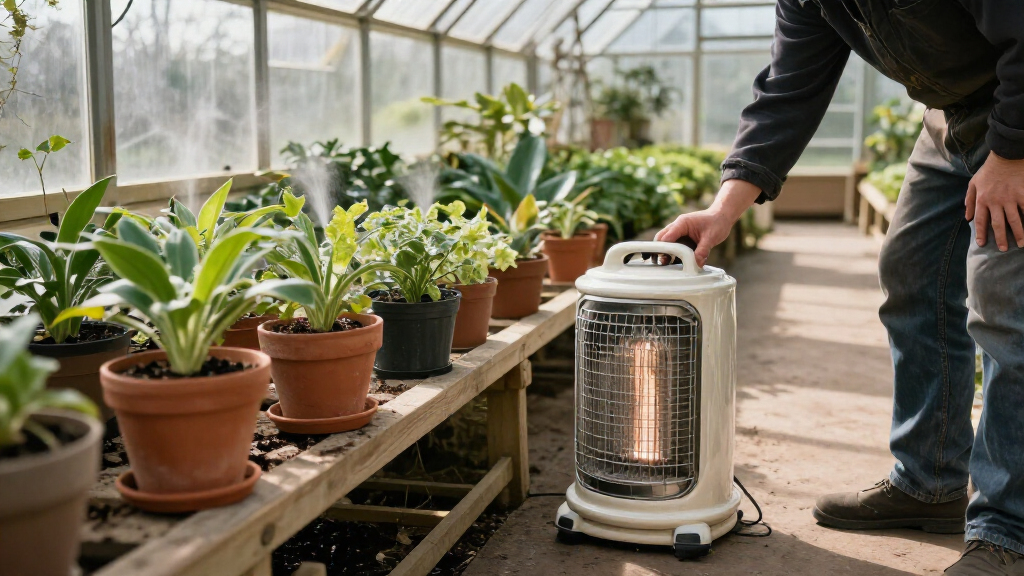
I ranked these heaters around the needs behind the search: maintaining a suitable temperature in indoor greenhouses, grow tents, and plant rooms. I compared the details provided for temperature control, heat output, heater type, and intended setting, then weighed how useful those features are in ordinary plant-care routines. I also looked at the likely tradeoffs between basic thermostat operation, digital settings, remote control, portability, and lower-power heating. No single output level or feature suits every growing space.
The ZIZIWIN comes first as the broadest-fit option because its stated 1500W output and digital thermostat align with common greenhouse needs. The Spider Farmer ranks as the more specialized tent choice, while Kiroto earns distinction for WiFi access rather than universal value. The remaining models are separated by their stated format and control features; where product details do not establish a meaningful advantage, I avoid treating the name or wattage alone as proof of better performance. Buyers should confirm each model’s safety instructions, coverage guidance, and suitability for humid environments before use.
| indoor plant heater | Heating method |
|---|---|
| ZIZIWIN Greenhouse Heater with | Convection |
| Air Choice Greenhouse Heater w | — |
| Joanolga 1500W Electric Patio | Forced air |
| Spider Farmer 530W PTC Grow Te | PTC heating |
| Air Choice 1500W Portable PTC | — |
| LHUKSGF Greenhouse Heater with | Forced air |
| VEVOR 1500W Greenhouse Heater | Forced air |
| Kiroto Smart Plant Heater 1500 | — |
| 1500W Greenhouse Heater with T | — |
| Noarixa 1500W Greenhouse Heate | Forced air |
Factors to Consider When Choosing Best Indoor Plant Heaters
Choosing an indoor plant heater starts with the conditions around the plants, not a feature checklist. These factors can help you avoid excess heat, uneven temperatures, and a heater that is poorly matched to the space.
Match Heater Output to the Enclosure
Start with the greenhouse or tent’s dimensions, insulation, and likely coldest temperature, then compare those needs with the heater’s stated coverage guidance. A 1500W unit may offer useful capacity for a greenhouse, but wattage alone cannot tell you whether it can hold a stable temperature in a drafty or poorly insulated space. Smaller enclosed grow areas may call for less output; the Spider Farmer’s 530W rating illustrates why lower-power models can be relevant for tents. Avoid choosing by plant count, since a few tropical plants in a cold room may need more support than many plants in a warm enclosure. If the manufacturer does not specify suitable coverage, ask for that information rather than assuming the unit will heat your space.
Check Thermostat Behavior and Sensor Placement
A thermostat helps regulate heat, but its reading only reflects the conditions near the sensor. If that area is warmer than the plant canopy, the heater may stop before the plants’ surroundings reach the intended temperature; a sensor in a cold draft can produce the opposite effect. Place any separate thermometer at plant level and away from direct heater airflow to see what the plants experience. Digital controls can make settings easier to read, while a WiFi app adds access from elsewhere but also relies on a working network and app support. Do not assume that a more elaborate control panel guarantees tighter temperature accuracy unless the manufacturer provides that information.
Account for Humidity, Water, and Electrical Safety
Greenhouses and grow tents can be humid, with watering adding splash risk near equipment. Check the heater’s instructions for moisture limits, required clearances, mounting or floor placement, and whether it is approved for the intended environment. A product described for greenhouse use is not automatically safe around standing water or direct spray. Keep cords and plugs away from wet surfaces, use an appropriate outlet, and follow the manufacturer’s guidance on extension cords and unattended operation. If the product’s moisture protection or permitted use is unclear, ask the seller or manufacturer before placing it in a humid enclosure.
Choose Between Directed Air and Gentle Enclosure Heating
Fan heaters can move warm air around a space, but direct airflow may dry leaves or growing media near the outlet. Position the heater so heat circulates without blowing continuously onto foliage, and check for cooler corners where air may not reach. A lower-output unit may suit a compact tent when the goal is to raise its baseline temperature rather than warm a large room quickly. Portable ceramic heaters can serve plant rooms, but they are not automatically interchangeable with greenhouse-specific models. Consider how the heater will distribute heat through the full enclosure, not only how warm the air feels directly in front of it.
Decide Whether Remote Control Earns Its Place
WiFi control is most useful when the heater is in a space you cannot check easily or when frequent setting changes are part of your routine. It can be less valuable for a small greenhouse beside the house, where local controls and a separate thermometer may provide adequate oversight. App features depend on connectivity and software support, so check what the heater can do if the network goes down. Remote control also does not replace safe placement, regular inspection, or an independent way to check temperatures. Pay for connected functions only if remote access solves a real problem in your setup.
Plan for Running Time and Maintenance
A heater’s operating cost depends on its power draw, how long it runs, and how much heat the enclosure loses. A high-wattage heater may bring a space up to temperature faster, yet frequent cycling in a drafty greenhouse can still use substantial energy. Improve insulation and seal avoidable drafts before trying to solve every temperature problem with a larger heater. Check whether the unit needs regular dust removal or other upkeep, and keep its intake and outlet clear as directed. For a long winter season, compare the heater’s expected duty cycle and maintenance needs alongside its initial features.
Frequently Asked Questions
Is a 1500W heater too powerful for a small grow tent?
It can be more output than a compact tent needs, particularly if the tent is insulated and the room around it is already warm. A thermostat may reduce unnecessary heating, but it does not remove the need to follow the heater’s clearance and placement rules. The Spider Farmer’s 530W rating is a lower-power alternative in this lineup for tent use, though the right choice depends on the tent and the coldest conditions it faces. Measure temperatures at plant level after setup rather than relying only on the heater’s control display. If temperatures rise quickly or swing widely, reassess placement and output instead of aiming the heater directly at plants.
Can I use a regular portable space heater around indoor plants?
A portable heater can warm the room where plants are kept, but that does not automatically make it suitable inside a greenhouse or grow tent. Enclosures can trap heat and moisture, and concentrated airflow may dry foliage or growing media. Check the manufacturer’s permitted environment, moisture guidance, and required clearances before using a general-purpose model near plants. Keep the heater on a stable surface with its airflow unobstructed and away from water. If the room is humid or the heater would sit inside an enclosure, a model specifically intended for that setting is the safer starting point.
Should I trust the heater’s thermostat without a separate thermometer?
A built-in thermostat is convenient, but its sensor may not measure the temperature where your plants sit. Heat can collect near the heater while the canopy or far end of a greenhouse remains cooler. Use a separate thermometer at plant height to compare the local reading with the heater’s display, especially during the first days of operation. Keep the thermometer out of direct airflow and away from cold drafts so it gives a useful reading of the growing area. Once you understand the temperature differences, you can adjust placement and settings with more confidence.
Is WiFi control worth choosing over a basic digital thermostat?
WiFi control makes the most difference when you need to change settings or check conditions while away from the growing space. If you can reach the heater easily and already monitor temperatures nearby, local digital controls may meet your needs with less dependence on an app or network. Check whether the app offers the controls you actually want and what happens if connectivity drops. A connected heater still needs safe installation and a separate temperature check near the plants. In this lineup, Kiroto is the connected-control choice, while the simpler thermostat models may suit a straightforward greenhouse routine.
What should I do if my greenhouse still has cold spots after adding a heater?
First check whether drafts, poor insulation, or the heater’s position are limiting circulation; adding more output may not fix uneven heat distribution. Move the heater only within the placement and clearance rules, and avoid directing a strong stream of hot air at leaves. Compare readings at several plant-level locations, including the coldest corner, to find where heat is failing to reach. You can also reduce avoidable heat loss by sealing gaps and insulating the enclosure where appropriate. If the heater’s stated coverage does not match the space, a better-sized model may be needed rather than a higher thermostat setting.
Conclusion
For most indoor greenhouse owners, I’d start with the ZIZIWIN Greenhouse Heater as the best overall fit: it pairs 1500W output with a digital thermostat and has a broad greenhouse focus. For the best value, I’d compare the Air Choice Greenhouse Heater and other straightforward 1500W thermostat models against the controls and safety details you need, rather than paying for extras you will not use. The Kiroto is my best premium-style choice for buyers who specifically want WiFi access, while ZIZIWIN’s digital thermostat makes it a sensible pick for beginners seeking direct controls. For compact grow tents, the lower-output Spider Farmer is the most specific match; for a plant room rather than an enclosure, consider the portable Air Choice ceramic heater only if its instructions suit that setting. Match the heater to your space, verify its moisture and placement guidance, and monitor temperatures at plant level before settling on a routine.