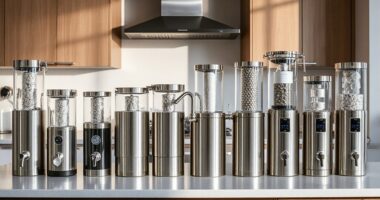
For most small greenhouses, I’d start with the BioGreen Palma, which pairs a 1500-watt heater with a fan and digital thermostat. The Dr. Infrared Heater DR218 is a simpler alternative, while the lesotc Smart Greenhouse Heater stands out for Wi-Fi control. The main tradeoffs are heat capacity, airflow, control convenience, and whether a heater is suited to your greenhouse’s electrical setup. A higher wattage does not automatically mean a better fit, especially in a small or poorly insulated space. Read on for my full comparison of all 15 greenhouse heaters and guidance on choosing one for your setup.

Get garden gear delivered free with Prime
- Fast, free delivery on millions of items
- Prime Video, Amazon Music and more included
- Member-only deals all year
Complete the kit


Key Takeaways
- The BioGreen Palma is my best overall pick because it combines a 1500-watt heater, fan, and digital thermostat in one greenhouse-oriented unit.
- Wi-Fi control is a convenience, not a substitute for capacity. The lesotc and Kiroto models add app-based control, but greenhouse size and heat loss still determine whether 1500 watts will suffice.
- The 3000-watt DR218-3000W is a different class of option. Its higher output may suit a larger or colder space, but it calls for careful attention to circuit capacity and installation requirements.
- Several 1500-watt picks share similar basic capabilities. TRUSTECH, Buyplus, ZIZIWIN, and the VEVOR models are best compared by controls, airflow, and practical fit rather than wattage alone.
- Two-pack and portable options solve different problems. The green two-pack may help spread heat across separate areas, while the Karveden patio heater is less greenhouse-specific than models built around thermostats and fan circulation.
| SmterCon Greenhouse Heater with Thermostat |  | Best for Straightforward Temperature Control | Power: 1500 W | Heating coverage: Up to 120 sq. ft. | Heating method: Convection | VIEW LATEST PRICE | See Our Full Breakdown |
| TRUSTECH Greenhouse Heater with Digital Thermostat, 1500W |  | Best for Flexible Manual Settings | Power: 750 W or 1500 W | Heating modes: Low heat, high heat, fan only | Thermostat range: 40°F–108°F (5°C–42°C) | VIEW LATEST PRICE | See Our Full Breakdown |
| lesotc Smart Greenhouse Heater with WiFi Thermostat, 1500W |  | Best for Remote Monitoring | Heating power: 1500 W | Coverage: Up to 150 sq. ft. | Thermostat range: 41°F–113°F | VIEW LATEST PRICE | See Our Full Breakdown |
| Buyplus Greenhouse Heater with Digital Thermostat, 1500W |  | Best for Broader Stated Coverage | Power: 1500 W heating; 25 W fan-only mode | Coverage: Up to 215 sq. ft. | Temperature range: 40°F–108°F (5°C–42°C) | VIEW LATEST PRICE | See Our Full Breakdown |
| Kiroto 1500W Wi-Fi Greenhouse Heater with App Control |  | Best for App-Controlled Scheduling | Power: 1500 W | Voltage and frequency: 110–120 V / 60 Hz | Amperage: 12.5 A | VIEW LATEST PRICE | See Our Full Breakdown |
| ZIZIWIN 1500W Greenhouse Heater with Digital Thermostat |  | Best for Simple Automatic Temperature Control | Power: 1500 watts | Heating method: Convection | Coverage: Up to 120 sq. ft. | VIEW LATEST PRICE | See Our Full Breakdown |
| VEVOR 1500W Greenhouse Heater with Thermostat and Fan |  | Best for Adjustable Heat and Airflow | Power: 1500 watts | Power source: 120V AC electric | Amperage: 12.5 A | VIEW LATEST PRICE | See Our Full Breakdown |
| 1500W Greenhouse Heater with Thermostat, 2-Pack, Green |  | Best for Heating Two Zones | Package contents: 2 heaters, 2 digital thermostats, 1 thermohygrometer, 1 user manual | Power supply: 110V AC / 60Hz | Power modes: 1500W high heat, 750W low heat, 24W fan | VIEW LATEST PRICE | See Our Full Breakdown |
| Pasapair 1500W WiFi Greenhouse Heater with Thermostat |  | Best for Scheduled Remote Control | Power: 1500 watts | Heating method: PTC ceramic | Heating coverage: 215 sq. ft. | VIEW LATEST PRICE | See Our Full Breakdown |
| Karveden 1500W Portable Electric Patio Heater |  | Best for Quiet, Flexible Heating | Power: 1500 watts | Heat settings: 25W natural air, 750W low heat, 1500W high heat | Coverage: Up to 215 sq. ft. | VIEW LATEST PRICE | See Our Full Breakdown |
| Dr. Infrared Heater DR218 1500-Watt Greenhouse Heater |  | Best for Small Greenhouses | Heating output: 1500 watts | Heating method: Forced air | Power: 120V, 12.5A | VIEW LATEST PRICE | See Our Full Breakdown |
| Dr. Infrared Heater DR218-3000W Greenhouse Infrared Heater, 3000-Watt |  | Best for Large Greenhouses | Power output: 3000 watts | Heating method: Radiant | Power requirement: 240V, 12.5A; 240V, 20A outlet specified | VIEW LATEST PRICE | See Our Full Breakdown |
| VEVOR 1500W Greenhouse Heater with Fan |  | Best Lightweight Pick | Power: 1500 watts | Voltage and amperage: 120V, 8.33A | Heating method: Forced air | VIEW LATEST PRICE | See Our Full Breakdown |
| Maygrove Greenhouse Heater with Digital Thermostat and Overheat Protection |  | Best for Probe-Based Temperature Control | Power settings: 750W and 1500W | Published coverage: 120 sq. ft. in description; 150 sq. ft. in specifications | Published thermostat range: 50–98°F in description; 40–95°F in specifications | VIEW LATEST PRICE | See Our Full Breakdown |
| BioGreen Palma Electric Greenhouse Heater and Fan with Digital Thermostat, 1500 W |  | Best for Damp Greenhouses | Power settings: 750W or 1500W | Heat output: 5,118 BTU/hr | Air circulation: Up to 5,800 ft³/hr | VIEW LATEST PRICE | See Our Full Breakdown |
| greenhouse heater | Dimensions | Power | Heating method |
|---|---|---|---|
| SmterCon Greenhouse Heater wit | 9.5 × 7.5 × 8.6 in (D × W × H) | 1500 W | Convection |
| TRUSTECH Greenhouse Heater wit | 7.99 × 9.25 × 4.52 in (D × W × H) | 750 W or 1500 W | Forced air, PTC ceramic |
| lesotc Smart Greenhouse Heater | 9.5 × 7.9 × 11 in | — | — |
| Buyplus Greenhouse Heater with | 14 × 10 × 10 in | 1500 W heating; 25 W fan-only mode | Convection |
| Kiroto 1500W Wi-Fi Greenhouse | — | 1500 W | — |
| ZIZIWIN 1500W Greenhouse Heate | 9.45 × 7.48 × 8.66 in | 1500 watts | Convection |
| VEVOR 1500W Greenhouse Heater | 10.63 × 8.66 × 12.8 in | 1500 watts | — |
| 1500W Greenhouse Heater with T | — | — | Convection |
| Pasapair 1500W WiFi Greenhouse | — | 1500 watts | PTC ceramic |
| Karveden 1500W Portable Electr | 12 × 10 × 7 in | 1500 watts | — |
| Dr. Infrared Heater DR218 1500 | 10 × 10 × 15 in. | 120V, 12.5A | Forced air |
| Dr. Infrared Heater DR218-3000 | 10 × 10 × 13 in. | — | Radiant |
| VEVOR 1500W Greenhouse Heater | 8.27 × 6.3 × 8.66 in. | 1500 watts | Forced air |
| Maygrove Greenhouse Heater wit | 10.04 × 11.61 × 9.06 in. | — | — |
| BioGreen Palma Electric Greenh | — | — | — |
More Details on Our Top Picks
SmterCon Greenhouse Heater with Thermostat
The SmterCon is a practical choice for growers who want a heater to maintain a set temperature without adding app controls. Its digital automatic thermostat switches the 1500W unit on and off as needed, while adjustable airflow can help move warmth around the greenhouse. Compared with the TRUSTECH, it gives up selectable heat levels and a stated thermostat range, so it offers less control over how you manage temperature. Its stated coverage of up to 120 sq. ft. is also smaller than the TRUSTECH’s, making it a better fit for a modest growing area than a larger greenhouse. Overheat protection and fireproof materials add reassurance, but the missing temperature range makes it harder to judge whether its settings suit temperature-sensitive plants.
Pros:- Automatically switches on and off to maintain a selected temperature
- Adjustable airflow can support heat circulation
- Overheat protection and fireproof materials are specified
- Compact floor-standing format
Cons:- Coverage is limited to spaces up to 120 sq. ft.
- No thermostat temperature range is provided
- No low-power heating mode is listed
Best for: Growers with a small greenhouse who want automatic temperature maintenance and adjustable airflow without app-based controls.
Not ideal for: Owners of greenhouses larger than 120 sq. ft. or growers who need a published thermostat range to manage specific plant temperatures.
- Power:1500 W
- Heating coverage:Up to 120 sq. ft.
- Heating method:Convection
- Thermostat:Digital, automatic temperature control
- Airflow:Adjustable ventilation and speed
- Safety:Independent overheat protection; fireproof materials
- Amperage:15 A
- Dimensions:9.5 × 7.5 × 8.6 in (D × W × H)
Our verdict“Choose the SmterCon for a small greenhouse where automatic temperature control matters more than detailed settings or broad coverage.”
TRUSTECH Greenhouse Heater with Digital Thermostat, 1500W
The TRUSTECH earns its place for growers who want more operating choices than a basic thermostat heater provides. It offers 750W and 1500W heat settings, plus fan-only operation, so you can use gentler heat or circulate air when heating is unnecessary. The digital thermostat spans 40°F–108°F and works with a waterproof sensor probe, giving it a clearer control range than the SmterCon, whose temperature range is not specified. Its stated coverage reaches 160 sq. ft., though that still falls short of the Buyplus heater’s stated 215 sq. ft. The TRUSTECH’s quick ceramic heating and adjustable tilt suit changing needs, but buyers should plan around its 7.5 ft cord and use the listed coverage as a limit rather than a guarantee for every greenhouse.
Pros:- Two heat settings and a fan-only mode provide flexible operation
- Digital thermostat adjusts from 40°F to 108°F
- Waterproof sensor probe supports greenhouse temperature sensing
- 90° adjustable tilt helps direct airflow
Cons:- Stated coverage is limited to 160 sq. ft.
- The 7.5 ft cord may restrict placement
- No app-based control is listed
Best for: Greenhouse owners who want a defined thermostat range, a lower heat setting, and a fan-only mode in one portable unit.
Not ideal for: Growers with areas larger than 160 sq. ft. or those who prefer app control and remote temperature alerts.
- Power:750 W or 1500 W
- Heating modes:Low heat, high heat, fan only
- Thermostat range:40°F–108°F (5°C–42°C)
- Coverage:Up to 160 sq. ft.
- Heating method:Forced air, PTC ceramic
- Tilt:90° adjustable
- Voltage:120 V
- Power cord:7.5 ft
- Dimensions:7.99 × 9.25 × 4.52 in (D × W × H)
Our verdict“Pick the TRUSTECH if you want a portable heater with a published thermostat range and useful low-heat and fan-only modes.”
lesotc Smart Greenhouse Heater with WiFi Thermostat, 1500W
For growers who cannot check the greenhouse constantly, the lesotc’s app control and temperature alerts are its main advantage. Its thermostat adjusts from 41°F to 113°F, and alerts can flag high or low temperatures, while 70° oscillation spreads moving air beyond a fixed direction. Compared with the TRUSTECH, the lesotc trades selectable 750W heating for remote management and a wider stated thermostat ceiling; compared with the similar Kiroto, it lists the same 150 sq. ft. coverage and oscillation but gives fewer details about timer settings. IPX4 protection and tip-over, overheat, and power-failure safeguards suit humid growing spaces, though the AC-powered unit still needs a suitable outlet and its coverage is modest for larger structures.
Pros:- App-based control and high- and low-temperature alerts
- Thermostat range extends from 41°F to 113°F
- 70° oscillation and fan mode support air circulation
- IPX4 rating plus overheat, tip-over, and power-failure protection
Cons:- Stated coverage is limited to 150 sq. ft.
- Requires an AC power source
- No lower wattage heating setting is listed
Best for: Growers who want to monitor greenhouse temperature remotely and receive alerts when conditions move outside their preferred range.
Not ideal for: Owners of large greenhouses or buyers who need a heater that can operate without an AC power source.
- Heating power:1500 W
- Coverage:Up to 150 sq. ft.
- Thermostat range:41°F–113°F
- Oscillation:70°
- Timer:24 hours
- Ingress protection:IPX4
- Safety features:Overheat protection, tip-over shutoff, power-failure protection
- Dimensions:9.5 × 7.9 × 11 in
- Weight:8.8 lb
Our verdict“Choose the lesotc when remote temperature checks and alerts matter more than multiple heat levels or coverage for a large greenhouse.”
Buyplus Greenhouse Heater with Digital Thermostat, 1500W
The Buyplus stands out in this group for its stated reach of up to 215 sq. ft., more area than the SmterCon, TRUSTECH, lesotc, or Kiroto claim. That makes it the more plausible fit for a larger greenhouse, although actual results will depend on insulation, outdoor conditions, and layout. Its 40°F–108°F digital thermostat, waterproof temperature probe, and 0°–45° angle adjustment offer practical control without the remote alerts or oscillation found on the lesotc. Fan-only operation is available, but the listed 25W fan mode may move less air than a dedicated circulation fan. At 14 × 10 × 10 inches, it is also larger than the compact SmterCon, so placement and clearance deserve attention.
Pros:- Highest stated coverage among these five heaters, up to 215 sq. ft.
- Digital thermostat adjusts from 40°F to 108°F
- Waterproof temperature probe is specified
- Portable handle and 0°–45° adjustable angle aid placement
Cons:- The 25W fan-only mode may provide limited air circulation
- Larger dimensions take up more floor space than the SmterCon
- No app control or oscillation is listed
Best for: Growers with a medium-sized greenhouse who prioritize greater stated coverage and a defined thermostat range over smart controls.
Not ideal for: Owners seeking app control, oscillating airflow, or a particularly compact heater for crowded growing spaces.
- Power:1500 W heating; 25 W fan-only mode
- Coverage:Up to 215 sq. ft.
- Temperature range:40°F–108°F (5°C–42°C)
- Modes:Fan-only and heating
- Heating method:Convection
- Power source:AC electric
- Cord length:7.5 ft
- Adjustable angle:0°–45°
- Dimensions:14 × 10 × 10 in
Our verdict“The Buyplus is the better fit for a larger greenhouse if broad stated coverage matters more than smart features or stronger fan-only circulation.”
Kiroto 1500W Wi-Fi Greenhouse Heater with App Control
The Kiroto is a smart-control alternative for growers who want to adjust heat remotely and set a schedule. Its app control, temperature monitoring, and 0–24-hour timer pair with a 41°F–113°F range, while 70-degree oscillation helps spread warm air across the growing area. It shares its 150 sq. ft. coverage and 1500W output with the lesotc, so the choice between them rests on details: Kiroto specifies voltage, amperage, and timer range, while lesotc lists IPX4 housing. Both offer heating and fan modes plus overheat, tip-over, and power-failure protection. At just 8 × 6 × 7 inches, the Kiroto has a compact footprint, but its AC requirement and limited coverage rule it out for off-grid or larger greenhouse setups.
Pros:- Wi-Fi app control with real-time temperature monitoring
- 0–24-hour timer supports scheduled operation
- 70-degree oscillation and fan mode aid air distribution
- Overheat, tip-over, and power-failure protection are listed
Cons:- Stated coverage is limited to 150 sq. ft.
- Requires a 110–120 V AC power source
- No ingress protection rating is specified, unlike the lesotc
Best for: Growers with a compact greenhouse who want app-based temperature monitoring, remote adjustments, and timer scheduling.
Not ideal for: Owners of greenhouses larger than 150 sq. ft., or growers who need off-grid operation or a listed water-resistance rating.
- Power:1500 W
- Voltage and frequency:110–120 V / 60 Hz
- Amperage:12.5 A
- Heating coverage:150 sq. ft.
- Temperature range:41°F–113°F (5°C–45°C)
- Timer:0–24 hours
- Control and modes:Wi-Fi app control; heating and fan
- Oscillation:70°
- Dimensions and weight:8 × 6 × 7 in; 8 lb
Our verdict“Choose the Kiroto for a small greenhouse where app-based adjustments and timer scheduling are more useful than a published water-resistance rating.”
ZIZIWIN 1500W Greenhouse Heater with Digital Thermostat
The ZIZIWIN is a straightforward pick for growers who want a heater to regulate temperature without relying on app setup or a weekly schedule. Its digital thermostat automatically controls heating, while the 1500W output is intended for spaces up to 120 sq. ft. That smaller stated coverage makes it a more sensible fit for a compact greenhouse than the Pasapair, which is listed for up to 215 sq. ft. Adjustable airflow adds flexibility for circulation when heat is not needed, though it is not a substitute for a dedicated ventilation system. At 3.5 pounds, it is also easier to reposition than the heavier VEVOR. The tradeoff is limited scale: this is not the choice for a large growing area, and the supplied details do not specify a weather-resistance rating, so I would keep it sheltered.
Pros:- Digital thermostat automatically controls temperature
- Designed for greenhouse spaces up to 120 sq. ft.
- Adjustable airflow supports circulation as well as heating
- Lightweight 3.5-pound design is easy to reposition
Cons:- Listed coverage is smaller than the Pasapair and Karveden models
- No weather-resistance rating is provided in the product details
- Only one listed heating power level, with no low-wattage heat mode
Best for: Growers with a small greenhouse or grow tent who want automatic thermostat control and a lightweight heater without smart-home features.
Not ideal for: Owners of greenhouses larger than 120 sq. ft. or anyone needing a heater explicitly rated for exposure to wet conditions.
- Power:1500 watts
- Heating method:Convection
- Coverage:Up to 120 sq. ft.
- Temperature control:Digital thermostat with adjustable settings
- Airflow:Adjustable speed
- Safety:Overheat protection; fireproof materials
- Dimensions:9.45 × 7.48 × 8.66 in
- Weight:3.5 lb
Our verdict“Choose the ZIZIWIN for a compact growing space where simple thermostat control matters more than wide coverage or app-based scheduling.”
VEVOR 1500W Greenhouse Heater with Thermostat and Fan
The VEVOR suits gardeners who want one portable unit for warming a greenhouse and moving air when heating is off. Its heat and fan modes, two temperature settings, and 25° angle adjustment provide more directional control than the ZIZIWIN, which lists adjustable airflow but not a tilting head. A temperature range of 40–108°F also gives a clear operating window for setting greenhouse conditions. The handle and stable base help when moving it between a growing area and a workbench, while overheat shutoff and an IPX4 rating add protection beyond the shelter-only guidance supplied for the two-heater kit. The compromise is bulk: at 7.1 pounds, it is notably heavier than the ZIZIWIN, and the product details do not state a coverage area. I would not choose it when matching heater output to a specific greenhouse size is the priority.
Pros:- Heating and fan modes let it circulate air without adding heat
- Two temperature settings and a stated 40–108°F range
- 25° adjustable angle helps direct airflow where it is needed
- Overheat shutoff, flame-retardant housing, and IPX4 protection
Cons:- No greenhouse coverage area is specified
- At 7.1 pounds, it is heavier than the ZIZIWIN
- Only two heating settings are listed, rather than the 750W and 1500W choices in the two-pack
Best for: Greenhouse owners who want a portable heater that can also circulate air and who value an adjustable direction of airflow.
Not ideal for: Buyers who need a stated coverage area to plan heat for a particular greenhouse, or who want a lightweight unit for frequent repositioning.
- Power:1500 watts
- Power source:120V AC electric
- Amperage:12.5 A
- Modes:Heating and fan
- Temperature range:40–108°F
- Adjustable angle:25°
- Protection:Overheat shutoff; IPX4
- Dimensions:10.63 × 8.66 × 12.8 in
- Weight:7.1 lb
Our verdict“Pick the VEVOR if adjustable airflow and fan-only operation matter more than a published coverage figure or low carrying weight.”
1500W Greenhouse Heater with Thermostat, 2-Pack, Green
This kit’s main advantage is scale through quantity: it includes two heaters and two digital thermostats, making it a better fit for separate greenhouse zones than a single-unit option such as the ZIZIWIN. Each heater offers fan-only, 750W, and 1500W modes, so growers can use lower heat when conditions are mild rather than running at full output. The included temperature and humidity monitor adds useful environmental information, while the stated ±1°F thermostat accuracy gives a clear reference for temperature control. Its limitations matter in greenhouse settings: the IP21 rating calls for shelter from direct rain and standing water, and the instructions caution against extended operation without supervision. I would treat this as equipment for a protected, monitored space—not an unattended heater for a damp or exposed structure.
Pros:- Two heaters and two thermostats can serve separate zones
- Fan-only, 750W, and 1500W modes offer more output choice than the single-setting ZIZIWIN
- Included thermohygrometer displays temperature and humidity
- Adjustable airflow, overheat shutoff, and flame-retardant housing
Cons:- IP21 rating means it must be kept away from direct rain and standing water
- Instructions caution against extended operation without supervision
- No coverage area is listed for either heater
Best for: Growers with two separated greenhouse areas who want individual thermostats, low- and high-heat settings, and a humidity monitor in one kit.
Not ideal for: People heating an exposed greenhouse or seeking a set-and-leave solution, since the IP21 rating requires shelter and the instructions caution against extended unsupervised operation.
- Package contents:2 heaters, 2 digital thermostats, 1 thermohygrometer, 1 user manual
- Power supply:110V AC / 60Hz
- Power modes:1500W high heat, 750W low heat, 24W fan
- Temperature control range:40–140°F
- Thermostat accuracy:±1°F
- Airflow:190 CFM
- Noise level:≤45 dB
- Heating method:Convection
- Ingress protection:IP21
Our verdict“Choose this kit for two sheltered greenhouse zones where adjustable output and environmental monitoring are more useful than unattended operation.”
Pasapair 1500W WiFi Greenhouse Heater with Thermostat
The Pasapair is the most control-focused pick here: it pairs WiFi app access with an external probe, wired thermostat, remote, and a programmable seven-day schedule. That setup is useful when growers want to adjust heating without walking to the greenhouse or schedule different routines across the week. The probe can measure conditions near plants or a work area rather than relying only on the heater’s location. Its stated 215 sq. ft. coverage also exceeds the ZIZIWIN’s 120 sq. ft. listing, making it a stronger candidate for a larger space. The tradeoff is added setup dependence: WiFi works on 2.4 GHz, not 5 GHz, and the unit is not intended for rain or direct water exposure. Compared with the simpler VEVOR, this offers more scheduling tools but asks more of the buyer’s network and setup.
Pros:- 2.4 GHz WiFi app control and a programmable seven-day schedule
- External temperature probe can monitor conditions away from the heater
- Listed coverage of 215 sq. ft. exceeds the ZIZIWIN’s stated area
- Four modes, adjustable tilt, child lock, and overheat protection
Cons:- WiFi requires a 2.4 GHz network and does not support 5 GHz
- Not intended for exposure to rain or direct water
- More controls and accessories require more setup than the VEVOR’s simpler mode selection
Best for: Growers with a larger, sheltered greenhouse who want to schedule heating remotely and monitor temperature at a specific spot with an external probe.
Not ideal for: Buyers with only 5 GHz WiFi, an exposed or rain-prone greenhouse, or a preference for simple manual controls over app setup.
- Power:1500 watts
- Heating method:PTC ceramic
- Heating coverage:215 sq. ft.
- Temperature range:41–108°F
- Modes:ECO, Fan Only, Low, High
- Controls:Onboard panel, remote, wired thermostat, Smart Life app
- WiFi compatibility:2.4 GHz
- Timer and schedule:24-hour countdown; 7-day programmable schedule
- Safety features:Overheat protection, child lock, flame-retardant materials, weighted base, non-slip feet
Our verdict“Choose the Pasapair if remote scheduling and probe-based temperature monitoring justify the WiFi setup in your sheltered greenhouse.”
Karveden 1500W Portable Electric Patio Heater
The Karveden is a greenhouse-friendly option for buyers who want three output modes and a quiet forced-air design without WiFi scheduling. Its settings range from 25W natural air to 750W low heat and 1500W high heat, so it can circulate air or deliver reduced heat when full output is unnecessary. The stated coverage reaches 215 sq. ft., matching the Pasapair’s listed area, while its roughly 35 dB noise level is lower than the two-heater kit’s stated maximum. Overheat and tip-over protections add safeguards, though the product is still a corded 120V appliance, not a fuel-free solution. I would also note that the listed automatic shutoff point is above 167°F while another maximum-temperature figure is 166°F; that discrepancy makes the exact cutoff less clear. Unlike the Pasapair, it lacks remote scheduling and an external probe.
Pros:- Three modes include natural air, 750W low heat, and 1500W high heat
- Listed coverage reaches 215 sq. ft., matching the Pasapair
- About 35 dB operating noise is quieter than the two-pack’s stated maximum
- Overheat, tip-over, and automatic shutoff protections
Cons:- Requires a corded 120V AC power source
- The listed maximum temperature figures differ slightly at 166°F and above 167°F
- Does not include the remote scheduling or external probe offered by the Pasapair
Best for: Growers heating a sheltered space up to 215 sq. ft. who want quiet operation, selectable output, and tip-over protection without app controls.
Not ideal for: People who need WiFi scheduling, an external temperature probe, or a heater that can operate without a corded AC supply.
- Power:1500 watts
- Heat settings:25W natural air, 750W low heat, 1500W high heat
- Coverage:Up to 215 sq. ft.
- Heating technology:PTC ceramic, forced air
- Fan speed:2600 RPM
- Noise level:About 35 dB
- Safety features:Overheat protection, tip-over protection, automatic shutoff above 167°F
- Electrical requirements:120 volts; 16 A
- Dimensions:12 × 10 × 7 in
Our verdict“Pick the Karveden for quiet, adjustable heating in a sheltered greenhouse when manual controls are enough and app scheduling is not needed.”
Dr. Infrared Heater DR218 1500-Watt Greenhouse Heater
The DR218 1500W is a straightforward choice for growers heating a small greenhouse or a defined growing area up to 150 square feet. Its adjustable thermostat and IPX4 splash protection suit damp greenhouse conditions better than an ordinary indoor space heater, while the portable 11.5-pound body can be repositioned as plants or benches change. Compared with the 3000-watt DR218, this model runs on 120V household power and avoids the need for a dedicated 240V, 20A outlet, but it is not the pick for a large space or severe cold. Its single heat setting also gives less control over output than the VEVOR or Maygrove, both of which offer multiple modes. I’d choose it for uncomplicated, thermostat-controlled heat where modest coverage is enough.
Pros:- Rated for spaces up to 150 square feet
- IPX4 housing resists splashing water
- Adjustable thermostat and overheat protection
- Portable design with a 120V power supply
Cons:- Only one heat setting, unlike the VEVOR and Maygrove
- 1500 watts may be inadequate for larger or especially cold greenhouses
Best for: Growers with a small greenhouse up to 150 square feet who want a portable heater that uses a standard 120V supply.
Not ideal for: Owners of large greenhouses or growers who want adjustable heat levels and fan-only operation.
- Heating output:1500 watts
- Heating method:Forced air
- Power:120V, 12.5A
- Temperature range:32–104°F
- Water resistance:IPX4
- Dimensions:10 × 10 × 15 in.
- Weight:11.5 lb
- Warranty:1 year
Our verdict“Choose this DR218 for simple, splash-resistant heating in a small greenhouse if one heat setting is enough.”
Dr. Infrared Heater DR218-3000W Greenhouse Infrared Heater, 3000-Watt
When the growing space is too large for a typical 1500-watt heater, the 3000-watt DR218 is the high-output option in this group, with stated coverage up to 600 square feet. Its 240V, 20A requirement is the key dividing line: compared with the 120V DR218 1500W, it offers substantially more heating capacity but needs compatible wiring and an outlet, so it is not a simple plug-in upgrade for every greenhouse. The IPX4 rating, adjustable thermostat, overheat protection, and steel housing make it better suited to a working greenhouse or semi-outdoor area than a basic indoor heater. At 13 pounds it remains movable, though less convenient than the 3.7-pound VEVOR. I’d favor it where available electrical service and larger-area heating matter more than portability.
Pros:- 3000-watt output with stated coverage up to 600 square feet
- IPX4 water-splash protection for damp greenhouse conditions
- Adjustable thermostat and overheat protection
- Heavy-duty steel housing and permanently lubricated motor
Cons:- Requires a 240V, 20A outlet, limiting where it can be installed
- Heavier than compact alternatives such as the VEVOR
- Higher output is unnecessary for many small greenhouse setups
Best for: Greenhouse owners with compatible 240V, 20A service who need a higher-output heater for a space approaching the stated 600-square-foot coverage.
Not ideal for: Growers with only standard 120V outlets, small greenhouses, or a need for a lightweight heater that is easy to reposition.
- Power output:3000 watts
- Heating method:Radiant
- Power requirement:240V, 12.5A; 240V, 20A outlet specified
- Water resistance:IPX4
- Dimensions:10 × 10 × 13 in.
- Weight:13 lb
- Housing:Heavy-duty steel
- Warranty:1 year limited
Our verdict“Pick the 3000W DR218 for a larger greenhouse only if your site has the required 240V, 20A supply.”
VEVOR 1500W Greenhouse Heater with Fan
The VEVOR’s strongest case is easy repositioning and flexible airflow: at 3.7 pounds, it is far lighter than either Dr. Infrared DR218, and its handle and angled head make it simple to aim warmth toward a bench or seedling area. Two heat levels and a fan-only mode also give it more day-to-day versatility than the single-setting DR218 1500W. That flexibility comes with a notable limitation: the supplied specifications list a maximum temperature of 75°C but do not give a greenhouse coverage area or thermostat range, so I would not choose it when precise temperature regulation or a defined heating footprint is the priority. It is best viewed as a portable spot heater and air circulator for modest setups, rather than a documented solution for a large greenhouse.
Pros:- Lightweight 3.7-pound body with a carrying handle
- Two heat settings plus fan-only operation
- 15° adjustable angle helps direct airflow
- Overheat protection and a stable floor base
Cons:- No coverage area or thermostat temperature range is provided
- Maximum temperature is listed as 75°C, which may not suit all plant-zone needs
Best for: Growers who move heat between benches or small growing zones and want a lightweight heater with selectable modes.
Not ideal for: Buyers who need a stated greenhouse coverage area or thermostat control to maintain a specific temperature.
- Power:1500 watts
- Voltage and amperage:120V, 8.33A
- Heating method:Forced air
- Modes:Low heat, high heat, and fan
- Maximum temperature:75°C
- Adjustable angle:15°
- Dimensions:8.27 × 6.3 × 8.66 in.
- Weight:3.7 lb
Our verdict“Choose the VEVOR for lightweight, movable heat and fan circulation, not for precisely specified greenhouse coverage.”
Maygrove Greenhouse Heater with Digital Thermostat and Overheat Protection
The Maygrove is the most control-focused choice here: its digital thermostat and 2 m external probe can read temperature away from the heater itself, which is useful when the plants sit on a bench or in a cooler corner. Dual 750W/1500W output and a fan-only mode give it more flexibility than the single-setting Dr. Infrared DR218 1500W. I would still treat its published coverage and thermostat limits cautiously: the product data gives conflicting figures for both, and its IP20 rating is not splash protection like the IPX4-rated Dr. Infrared and BioGreen models. The compact 4.4-pound design suits indoor growing spaces, but it is a weaker fit for a damp greenhouse where splashes or dust exposure are concerns. It stands out for temperature sensing, not weather resistance.
Pros:- External 2 m probe can monitor temperature away from the heater
- 750W and 1500W heat settings plus fan-only mode
- Overheat auto-shutdown and flame-retardant housing
- Lightweight 4.4-pound design
Cons:- Product details give conflicting thermostat ranges and coverage figures
- IP20 rating does not provide the splash protection offered by the Dr. Infrared and BioGreen heaters
Best for: Indoor greenhouse growers who want an external probe to monitor a plant zone and can keep the heater in a dry, protected location.
Not ideal for: Growers in splash-prone greenhouses or buyers who need dependable, clearly stated coverage and temperature specifications.
- Power settings:750W and 1500W
- Published coverage:120 sq. ft. in description; 150 sq. ft. in specifications
- Published thermostat range:50–98°F in description; 40–95°F in specifications
- Temperature probe:2 m external probe
- Noise level:34 dB
- Dimensions:10.04 × 11.61 × 9.06 in.
- Weight:4.4 lb
Our verdict“Choose the Maygrove for probe-based control in a dry indoor growing space, but verify the temperature and coverage specifications before buying.”
BioGreen Palma Electric Greenhouse Heater and Fan with Digital Thermostat, 1500 W
The BioGreen Palma is a strong fit for growers who need both thermostat-controlled heat and air circulation in a damp greenhouse. Its two heat levels can reduce output when full power is unnecessary, while fan mode moves air without adding heat; the stated circulation rate is up to 5,800 cubic feet per hour. Unlike the Maygrove, the Palma pairs digital temperature control with IPX4 splash protection and a stainless steel housing, which makes its greenhouse-oriented construction a clearer match for humid conditions. Its stated coverage is limited to 120 square feet, however, and the specified 120V, 15A supply may require a dedicated circuit. I’d pick it over the single-setting DR218 1500W when airflow and selectable output matter, but not for a large space or a lower-capacity electrical circuit.
Pros:- Two heating levels and a fan-only mode
- Digital thermostat with a broad stated temperature range
- IPX4 splash protection and stainless steel housing
- Air circulation rated up to 5,800 cubic feet per hour
Cons:- Rated for only up to 120 square feet
- Requires a 120V, 15A supply
- Maximum stated thermostat setting of 185°F is far above typical plant-zone targets
Best for: Growers with a greenhouse up to 120 square feet who want adjustable heat, fan-only circulation, and splash-resistant construction.
Not ideal for: Owners of larger greenhouses or anyone without a suitable 120V, 15A electrical supply.
- Power settings:750W or 1500W
- Heat output:5,118 BTU/hr
- Air circulation:Up to 5,800 ft³/hr
- Thermostat range:32–185°F
- Electrical supply:120V, 15A
- Housing:Stainless steel
- Water resistance:IPX4 splash-proof
Our verdict“Choose the Palma for a small, damp greenhouse where adjustable heat and strong air circulation matter more than broad coverage.”

How We Picked
I compared the 15 options on factors that affect day-to-day greenhouse use: stated wattage, thermostat type, airflow, control method, portability, and features such as overheat protection. I gave more weight to a useful combination of heating and temperature control than to a single headline feature. Greenhouse heaters need to suit both the plants and the space, so I also considered whether a model appears practical for small, enclosed growing areas or offers features that help distribute warmth.
The ranking favors versatile greenhouse-oriented models first, followed by options with a clear advantage for a particular buyer, such as app control, higher output, or a two-unit setup. Several products are 1500-watt electric heaters with similar basic roles, so I distinguish them by their controls and additional functions rather than treating their output as a reason to rank them alike. Product details alone cannot establish how much space a heater will warm; greenhouse insulation, outside temperatures, and electrical capacity all affect that result. I did not treat Wi-Fi, wattage, or portability as automatic advantages when they may not suit every setup.
| greenhouse heater | Heating method |
|---|---|
| SmterCon Greenhouse Heater wit | Convection |
| TRUSTECH Greenhouse Heater wit | Forced air, PTC ceramic |
| lesotc Smart Greenhouse Heater | — |
| Buyplus Greenhouse Heater with | Convection |
| Kiroto 1500W Wi-Fi Greenhouse | — |
| ZIZIWIN 1500W Greenhouse Heate | Convection |
| VEVOR 1500W Greenhouse Heater | — |
| 1500W Greenhouse Heater with T | Convection |
| Pasapair 1500W WiFi Greenhouse | PTC ceramic |
| Karveden 1500W Portable Electr | — |
| Dr. Infrared Heater DR218 1500 | Forced air |
| Dr. Infrared Heater DR218-3000 | Radiant |
| VEVOR 1500W Greenhouse Heater | Forced air |
| Maygrove Greenhouse Heater wit | — |
| BioGreen Palma Electric Greenh | — |
Factors to Consider When Choosing Greenhouse Heaters
Choosing greenhouse heat starts with the space and the conditions you need to protect, not with a feature list. These checks can help prevent overspending on controls you won’t use or choosing an electric heater that cannot keep up with heat loss.
Match Output to Heat Loss, Not Just Floor Area
A heater’s wattage gives you a starting point, but it cannot predict performance by itself. Drafts, glazing, greenhouse height, and the gap between outdoor lows and your target temperature all affect how quickly warmth escapes. A 1500-watt model may suit a compact, better-sealed greenhouse but struggle in a larger or exposed structure. The 3000-watt DR218-3000W offers more output, yet it also places greater demands on the electrical supply. Avoid choosing by square footage alone; consider how cold the site gets and whether you can reduce leaks before buying a larger heater. If conditions vary widely, a thermostat can help regulate heat rather than leaving the unit running continuously.
Choose Controls That Fit How You Tend Plants
A basic thermostat may be enough if you check the greenhouse often and only need to maintain a steady temperature. Digital controls can make temperature settings easier to read and adjust, while Wi-Fi models such as the lesotc, Kiroto, and Pasapair can offer remote management. Remote access is most useful when you cannot reach the greenhouse quickly, but it depends on a reliable connection and does not remove the need to check the actual environment. Think about whether you’ll use app access in routine care or only during an occasional cold spell. Also check how the heater behaves after a power interruption, since control convenience matters less if the settings do not suit your schedule. Pay for connected features when they solve a real monitoring problem, not simply because they are available.
Decide Whether Air Circulation Matters
Heating and distributing heat are related but different jobs. A fan-equipped heater can move warm air around a greenhouse, which may help reduce colder pockets compared with heat that stays concentrated near the unit. Models such as the BioGreen Palma and VEVOR fan heaters combine those functions, while a heater without a fan may be simpler for a small area or a targeted location. Air movement can also affect delicate plants, so placement and direction matter; a warm draft aimed directly at foliage may not be desirable. Consider whether your greenhouse already has a circulation fan before paying for another one built into a heater. For a divided or long growing space, two lower-output units may distribute warmth differently from one powerful unit, but that setup adds equipment and electrical load.
Check Power, Placement, and Safety Before Installation
Electric greenhouse heaters need a suitable power source and a safe position away from water, plant material, and anything that could obstruct airflow. Confirm the product’s electrical requirements and your circuit capacity before selecting a 1500-watt or 3000-watt unit. Higher output can be especially demanding, and using an unsuitable extension lead or overloaded circuit can create hazards. Overheat protection, where offered, is useful but does not replace proper placement or routine checks. Follow the manufacturer’s instructions for damp locations, clearances, and mounting or floor placement. If the greenhouse is wet or exposed, verify that the heater is rated for the conditions rather than assuming that a greenhouse label alone settles the question.
Weigh One Heater Against Multiple Units
One heater is easier to position and manage, but it can leave distant corners cooler if the greenhouse is long or partitioned. A two-pack can let you place heat in separate zones, though it does not automatically provide better temperature control or lower energy use. Two units running together may draw more power than a single heater, so check the total load and how each unit is controlled. Portable models can be repositioned as growing needs change, but portability is less valuable if the heater is intended to stay in one safe, fixed location. Compare the cost and complexity of multiple units with the benefit of more even coverage. For a single compact greenhouse, a well-placed thermostatic heater may be the simpler choice.
Prioritize Features You Will Maintain
A heater is part of a seasonal routine, so choose controls and construction you can inspect and keep clean. Fan-equipped units may need more attention to dust and airflow than simpler designs, especially in a space with soil, compost, and plant debris. Digital displays and apps add convenience but also create more settings to learn and check. If you want uncomplicated operation, a straightforward thermostat may be easier to manage than remote controls. Review the instructions for cleaning, storage, and any required checks before committing to a model. A heater that fits your habits is more useful than one with extra functions you are unlikely to maintain.
Frequently Asked Questions
Is a 1500-watt greenhouse heater enough for my greenhouse?
It may be enough for a small, well-sealed greenhouse, but wattage alone cannot confirm that. Glass or film type, drafts, greenhouse height, and local overnight temperatures all affect the heat required. A 1500-watt unit is the common output across many picks in this roundup, so the deciding factor is often the growing space rather than a small difference in features. If the structure loses heat quickly or you need to protect plants through severe cold, consider improving insulation or checking whether a higher-output heater and circuit are appropriate. Monitor greenhouse temperatures during cold conditions before relying on one unit to protect sensitive plants.
Should I choose a Wi-Fi greenhouse heater or a digital thermostat model?
Choose Wi-Fi if remote access would change how you manage the greenhouse, such as when it is far from your home or you are away overnight. A digital thermostat is often enough if you can check and adjust the heater in person. App control does not increase a heater’s wattage, fix heat loss, or replace a reliable temperature reading inside the growing space. Before buying a connected model, check that its control method suits your network and that you are comfortable relying on an app. If not, a simpler thermostat may offer the more dependable routine for your setup.
When does a 3000-watt greenhouse heater make more sense than a 1500-watt model?
A 3000-watt heater may be worth considering when the greenhouse has greater heat loss or needs more output than a typical 1500-watt unit can provide. It is not automatically the better choice for a small greenhouse, where the extra capacity may be unnecessary. Check the heater’s electrical requirements and confirm that the circuit can safely support it before purchase. A higher-output heater also cannot compensate for major drafts or poor insulation as efficiently as addressing those problems directly. Compare the DR218-3000W with a 1500-watt option only after accounting for space, climate, and available power.
Is a fan-equipped heater better for protecting plants from cold spots?
A fan can circulate warm air and may help reduce temperature differences between areas of a greenhouse. That can be useful in a longer or divided space, but results depend on the layout and where the heater sits. It does not guarantee even temperatures, and a direct stream of warm air may be unsuitable for plants placed close to the unit. If you already use a separate circulation fan, a heater without one may meet your needs with less overlapping equipment. Use a thermometer in more than one location to find out whether your greenhouse has cold spots before deciding which setup to buy.
Can I run two greenhouse heaters on the same circuit?
That depends on the circuit’s capacity and the combined electrical load of both heaters and any other equipment running at the same time. Two 1500-watt heaters can demand substantially more power together than one, so do not assume a two-pack can share a standard outlet safely. Check the product instructions and the circuit rating, and ask a qualified electrician if you are unsure. Avoid relying on an extension lead unless the manufacturer explicitly permits one and its rating is suitable for the load and environment. The two-pack can help place heat in separate areas, but safe power planning must come first.
Conclusion
For the best overall fit, I recommend the BioGreen Palma for buyers who want heat, fan circulation, and a digital thermostat in one greenhouse-focused unit. For value, compare the 1500-watt thermostat models—including TRUSTECH, Buyplus, ZIZIWIN, and VEVOR—by the controls and airflow you actually need, rather than paying extra for overlapping features. For a premium control experience, choose a Wi-Fi option such as lesotc or Kiroto if remote access is useful in your routine. For beginners, a straightforward thermostatic 1500-watt heater is the clearest starting point, provided its output fits the greenhouse and its electrical supply. For a larger or colder greenhouse, consider the 3000-watt DR218-3000W only after checking circuit capacity; for separate zones, the two-pack may suit better. My final choice would depend on heat loss first, then the controls and extras that make daily management easier.