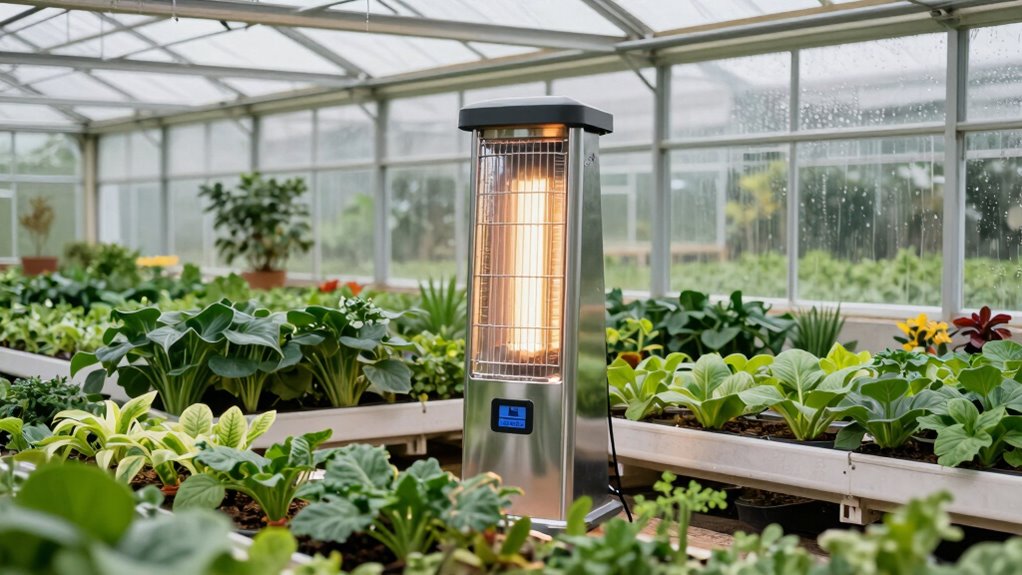

A 1500W heater is not enough to heat most 20×30 greenhouses on its own; it is better suited to frost protection or a small, insulated zone. For the strongest listed output, the Dr. Infrared Heater DR218-3000W stands out, while the Bio Green PHX 2.8/US Phoenix offers a higher-voltage option and the BioGreen PALMA 1500W adds a fan for heat circulation. Your main tradeoffs are electrical capacity, insulation, how evenly heat reaches plants, and whether you need app or thermostat controls. A single portable unit may suit a mild climate or localized growing area, but a large, leaky greenhouse may call for multiple circuits or a dedicated heating system. Read on for the full breakdown and a practical way to match a heater to your greenhouse conditions.

Get garden gear delivered free with Prime
- Fast, free delivery on millions of items
- Prime Video, Amazon Music and more included
- Member-only deals all year
Complete the kit


Key Takeaways
- Rated wattage sets a hard ceiling: most entries here are 1500W, so they are better framed as supplemental or zone heaters than whole-house heat for an uninsulated 20×30 greenhouse.
- The Dr. Infrared DR218-3000W has the highest listed wattage in this lineup, but its electrical draw and circuit needs deserve more attention than its output headline.
- The Bio Green PHX 2.8/US Phoenix is a different class of option: its 220–240V requirement and 9553 BTU listing make it unsuitable for a standard outlet without compatible supply.
- Thermostat and app features improve control, not capacity: smart controls can reduce unnecessary run time, but they do not make a 1500W unit heat a large, drafty structure like a larger system.
- Air movement is a meaningful separator: the PALMA combines heating with a fan, while other models prioritize portability, adjustable direction, or remote control; match that feature to your layout rather than choosing by name alone.


| greenhouse heater for 20×30 | Stated coverage | Power | Heating method | Dimensions |
|---|---|---|---|---|
| Pasapair Greenhouse Heater wit | 215 sq ft | 1500W | Electric PTC ceramic | — |
| 1500W Greenhouse Heater with A | 150 sq ft | — | — | — |
| BioGreen Electric Greenhouse H | 120 sq ft | 1500W | — | — |
| Pasapair Greenhouse Heater wit | 215 sq ft | 1500W | — | 9.45 x 11.2 x 6.6 in |
| Bio Green PHX 2.8/US Phoenix G | 215 sq ft | 2800W | — | — |
| Greenhouse Heater with Digital | 120 sq ft | 1500W | Convection | — |
| Greenhouse Heater with Thermos | — | — | Convection | 9.5 × 8.5 × 9.5 in |
| VEVOR Greenhouse Heater with T | — | 1500W | Forced air | 6.29 × 6.29 × 8.66 in |
| Dr. Infrared Heater DR218-3000 | 600 sq ft | — | Radiant | — |
| VEVOR Greenhouse Heater | — | 1500W | Forced air | 10.63 × 8.66 × 12.8 in |
| Greenhouse Heater with Digital | Up to 160 sq. ft. | 1500W | Forced air | 7"D × 9.4"W × 12"H |
| Greenhouse Heater with Thermos | Up to 200 sq. ft. | — | — | 13.99"D × 11"W × 7"H |
More Details on Our Top Picks
Pasapair Greenhouse Heater with Remote, 1500W Fast Heating for Grow Tent
For a 20×30 greenhouse, this Pasapair is best viewed as a targeted heater, not a whole-space solution: its stated coverage is 215 square feet, far below a 600-square-foot footprint. The remote, digital display, and 90-degree oscillation make it easier to adjust heat across a plant zone without walking back to the unit. Compared with the Pasapair WiFi model, it offers straightforward remote operation but lacks the listed external temperature probe and app scheduling. Its PTC ceramic heating and fan-only mode add flexibility, while overheat protection and tip-over resistance address basic operating risks. The main tradeoff is limited reach; heating a 20×30 greenhouse evenly would likely require more capacity or multiple heat sources, along with careful attention to placement and electrical load.
Pros:- Remote and digital display allow adjustments without reaching the heater.
- 90-degree oscillation helps spread warmth across a local area.
- PTC ceramic heat plus fan-only and ECO modes provides more than one operating option.
- Overheat protection and tip-over resistance add basic safety safeguards.
Cons:- Stated 215-square-foot coverage is much smaller than a 20×30 greenhouse.
- No warranty information is specified.
- Requires a stable, flat placement surface and a nearby outlet for its 6.5-foot cord.
Best for: Growers with a partitioned 20×30 greenhouse who need remote control for one roughly 215-square-foot work or plant zone.
Not ideal for: Growers expecting one heater to maintain an even temperature throughout an unpartitioned 20×30 greenhouse.
- Power:1500W
- Stated coverage:215 sq ft
- Heating method:Electric PTC ceramic
- Modes:ECO, fan-only, heating low/high
- Oscillation:90 degrees
- Controls:Digital display and remote control
- Weight:4 lb
- Cord length:6.5 ft
Our verdict“Choose this Pasapair for convenient remote control of a defined greenhouse zone, not as the sole heater for a 20×30 space.”
1500W Greenhouse Heater with App Remote Control and Thermostat
This model’s standout is app control with temperature alerts, which suits growers who want to check or adjust a smaller greenhouse zone while away. Its listed coverage is 150 square feet, making it a particularly limited choice for a 20×30 greenhouse; it should be treated as a spot heater or part of a multi-heater plan. Compared with the Pasapair heater with remote, this unit offers Wi-Fi scheduling and alerts rather than relying on a handheld remote, but its operation depends on a Wi-Fi connection. The 70-degree swing and fan mode can help distribute warmth within its rated area, and the listed FCC and UL certifications provide useful product information. The tradeoff is that smart control cannot compensate for the coverage gap, and heating stops during a power outage.
Pros:- Smart Life app supports remote temperature control, scheduling, and real-time alerts.
- 70-degree swing and fan mode help circulate warmth in the stated area.
- Temperature settings range from 41°F to 113°F.
- Overheat and tip-over protection are listed, along with FCC and UL certifications.
Cons:- Rated coverage of 150 square feet is a small fraction of a 20×30 greenhouse.
- App features require a Wi-Fi connection.
- No battery backup is listed, so heating stops if mains power fails.
Best for: Greenhouse owners who want smartphone temperature alerts and scheduling for a small, connected plant area within a larger 20×30 structure.
Not ideal for: Growers without dependable Wi-Fi or anyone seeking a single heater for the full 600-square-foot greenhouse.
- Power output:1500W
- Stated coverage:150 sq ft
- Amperage:12.5A
- Control:Wi-Fi and Smart Life app
- Temperature setting range:41°F to 113°F
- Modes:Heating, fan, and swing
- Oscillation:70 degrees
- Safety features:Overheating and tip-over protection
Our verdict“Pick this heater for app-managed monitoring of a small greenhouse zone, but not for whole-house coverage or locations with unreliable Wi-Fi.”
BioGreen Electric Greenhouse Heater & Fan with Digital Thermostat PALMA 1500W
The PALMA is the lineup’s more greenhouse-focused pick for damp conditions and air circulation. Its IPX4 splash-proof rating and stainless-steel construction suit environments where condensation and splashes are part of daily growing, while the fan moves a listed 5,800 cubic feet of air per hour. That fan function is useful for circulation, but it does not change the heater’s stated 120-square-foot coverage—one of the smallest figures here and far short of a 20×30 footprint. Compared with the Bio Green PHX 2.8/US Phoenix, the PALMA uses a standard 120V supply and is easier to position as a compact unit, but it provides less coverage and no remote control. Its adjustable 750W or 1500W elements offer a lower setting for more restrained heating; the tradeoff is that larger spaces need another heating plan.
Pros:- IPX4 splash-proof design suits damp greenhouse environments.
- Fan circulates a listed 5,800 cubic feet of air per hour.
- Adjustable 750W and 1500W heating elements allow a lower-power setting.
- Stainless-steel body and compact, portable form support flexible placement.
Cons:- Stated coverage is only 120 square feet, far below a 20×30 footprint.
- No remote control is included.
- Requires a 120V, 15A power source.
Best for: Growers who need splash-resistant heat and air circulation for a damp, partitioned greenhouse area with standard 120V power.
Not ideal for: Owners who need one heater for a 20×30 greenhouse or remote adjustments from outside the growing area.
- Power:1500W
- Heating element settings:750W or 1500W
- Stated coverage:120 sq ft
- Heat output:5100 BTU/hr
- Air circulation:5800 ft³/h
- Voltage and amperage:120V, 15A
- Water resistance:IPX4 splash-proof
- Material:Stainless steel
Our verdict“Choose the PALMA for splash-resistant heating and circulation in a small greenhouse zone, not as a standalone 20×30 solution.”
Pasapair Greenhouse Heater with Thermostat, 1500W WiFi PTC for Grow Tent
For growers who want to manage conditions around the plants rather than at the heater itself, this Pasapair’s external probe and 7-day schedule make it the most control-oriented 1500W option in this group. The probe can monitor a chosen spot in the growing area, while app, remote, and onboard controls give several ways to change settings. Its stated 215-square-foot coverage still leaves most of a 20×30 greenhouse outside the rated area, so its strongest use is as a controlled zone heater. Compared with the 1500W app-controlled heater, this model adds a probe and listed weekly scheduling, though that other unit includes real-time alerts and swing oscillation. The 2.4 GHz Wi-Fi requirement and limited cord reach can complicate setup; the UL certification is a useful detail, but it does not resolve the coverage mismatch.
Pros:- External probe supports temperature monitoring away from the heater body.
- App, remote, and onboard controls offer several adjustment methods.
- 7-day schedule and 24-hour timer support planned operation.
- UL certification and multiple heat and fan modes are listed.
Cons:- Stated 215-square-foot coverage is insufficient for a 600-square-foot greenhouse.
- Wi-Fi works with 2.4 GHz networks, not 5 GHz.
- Power cord length may restrict placement in a large greenhouse.
Best for: Growers who want scheduled, probe-based temperature control for a specific plant zone and have a 2.4 GHz Wi-Fi network.
Not ideal for: Buyers seeking one heater for an entire 20×30 greenhouse, or growers whose network uses only 5 GHz Wi-Fi.
- Power:1500W
- Stated coverage:215 sq ft
- Temperature range:41°F to 108°F
- Controls:Wi-Fi app, remote, digital thermostat, and onboard controls
- Temperature sensing:External probe
- Scheduling:7-day schedule and 24-hour timer
- Dimensions:9.45 x 11.2 x 6.6 in
- Safety certification:UL certified
Our verdict“Choose this model when probe placement and scheduled control matter more than whole-greenhouse coverage.”
Bio Green PHX 2.8/US Phoenix Greenhouse Heater – 220-240V, 9553 BTU, Stainless Steel, Electric Heating and Cooling System
The Phoenix stands apart by offering 2800W of power, more than the 1500W models in this lineup, making it the stronger candidate when a 20×30 greenhouse needs a higher-output heater. Its stated coverage is still only 215 square feet, however, so the listed data does not support treating it as a complete solution for 600 square feet. Adjustable 1000W and 1800W elements let the grower choose between lower and higher output, and the heater also supports ventilation. Compared with the BioGreen PALMA, the Phoenix has greater listed power and coverage but requires 220–240V, which can mean a dedicated compatible circuit rather than a standard 120V outlet. Stainless-steel construction and floor or hanging mounting expand placement options; the voltage requirement and unresolved whole-space coverage are the main compromises.
Pros:- 2800W output exceeds the 1500W models in this batch.
- Adjustable 1000W and 1800W heating elements provide output choices.
- Heating and ventilation functions support both warming and air movement.
- Stainless-steel construction and floor or hanging mounting offer durable, flexible placement.
Cons:- Requires 220–240V power, limiting use where a compatible supply is unavailable.
- Stated coverage of 215 square feet remains well below a 20×30 greenhouse footprint.
- Noise level is not specified in the provided product data.
Best for: Growers with a compatible 220–240V supply who need more heating output for a defined greenhouse zone or a larger multi-heater setup.
Not ideal for: Owners limited to standard 120V outlets or those expecting a single unit to heat an entire 20×30 greenhouse.
- Power:2800W
- Voltage:220–240V
- Heat output:9553 BTU
- Stated coverage:215 sq ft
- Heating elements:1000W and 1800W adjustable
- Thermostat range:-58°F to 79°F
- Material:Stainless steel
- Mounting:Floor or hanging
Our verdict“Pick the Phoenix for higher output and flexible mounting when you have 220–240V power, but plan additional capacity for a full 20×30 greenhouse.”
Greenhouse Heater with Digital Thermostat, 1500W Electric Heater
For a 20×30 greenhouse, this 1500W model is better treated as a spot heater than a whole-house solution: its stated 120 sq ft coverage reaches only a portion of the 600 sq ft footprint. The digital thermostat gives it a clearer temperature-control advantage over the VEVOR 1500W heater with adjustable angle, whose listed specs do not state a temperature range. PTC ceramic fast heating can help warm a nearby bench or protected growing area quickly, while IPX5 water resistance adds a measure of protection in damp conditions. Its drawbacks are the limited coverage and dependence on an electrical outlet; I would not rely on one unit to hold an even temperature across the full greenhouse.
Pros:- Digital thermostat supports more precise temperature control than a simple fixed-output heater.
- PTC ceramic heating is described as fast-warming for localized use.
- IPX5 water-resistance rating suits damp conditions better than the VEVOR 1500W model with IP20 protection.
- Overheat protection and flame-resistant construction add safety features.
Cons:- Listed coverage is only 120 sq ft, far short of a 600 sq ft greenhouse.
- Requires an electrical outlet and does not provide a non-electric heat option.
- Product data does not specify weight, making portability harder to judge.
Best for: Growers who want thermostat-controlled supplemental heat for a 120 sq ft plant bench or section inside a larger greenhouse.
Not ideal for: Anyone expecting one plug-in heater to warm a full 20×30 greenhouse evenly, or buyers without a suitable electrical outlet nearby.
- Power:1500W
- Stated coverage:120 sq ft
- Heating method:Convection
- Temperature control:Digital thermostat
- Water resistance:IPX5
- Mounting type:Floor
- Safety features:Overheat protection; flame resistant
Our verdict“Choose it for controlled supplemental heat in one small greenhouse zone, not as the sole heater for a 20×30 structure.”
Greenhouse Heater with Thermostat, Digital Temperature Display, Fast Heating, Overheat Protection, Electric for Grow Tent and Patio
This pedestal-style 1500W heater suits a small grow tent or sheltered patio zone better than a full 20×30 greenhouse. Its digital temperature display and adjustable thermostat make settings easier to read, while adjustable speed and automatic power control give it more operating flexibility than the Greenhouse Heater with Digital Thermostat, which lists multiple power modes but does not specify a display or dimensions. The reported 120 sq ft limit remains the main constraint: that is a fraction of a 20×30 greenhouse, so I would use it for a defined growing area rather than expect whole-structure heat. It also calls for a 15A-capacity outlet, and its pedestal form may take up valuable space in a compact tent.
Pros:- Digital temperature display makes operating settings easy to read.
- Adjustable temperature and speed allow more control than a fixed-output heater.
- Automatic power control is designed to reduce unnecessary operation.
- Overheat protection is included.
Cons:- Listed coverage is limited to 120 sq ft, not enough for a 20×30 greenhouse.
- Requires an outlet with 15A capacity, which can restrict placement.
- Pedestal design may occupy too much floor area in a crowded grow tent.
Best for: Growers heating a compact tent or patio work area who want a visible temperature display and adjustable airflow.
Not ideal for: Owners of a 20×30 greenhouse seeking one heater for the whole space, or anyone without a 15A-capacity outlet.
- Power output:1500W
- Voltage:AC/DC (as listed)
- Amperage:15A
- Dimensions:9.5 × 8.5 × 9.5 in
- Form factor:Pedestal
- Heating method:Convection
- Controls and features:Electronic thermostat, adjustable temperature and speed, fast heating
Our verdict“Pick this for a smaller tent or patio zone when readable controls matter more than broad greenhouse coverage.”
VEVOR Greenhouse Heater with Thermostat, 1500W PTC Fast Heating, 3-Speed, Portable Indoor Fan Heater for Greenhouse and Grow Tent
At 6.29 × 6.29 × 8.66 inches and 4.5 pounds, this VEVOR is the easiest option here to place beside a propagation tray or move between small growing areas. Its three-speed forced-air output offers more airflow adjustment than the Dr. Infrared DR218, which instead serves much broader areas with 3000W radiant heat. That comparison also shows the limit: this compact VEVOR is a local heater, not a credible single-unit answer for a 600 sq ft greenhouse. Its thermostat and overheat protection are useful, but its IP20 protection is weaker than the IPX4 or IPX5 ratings on several alternatives, so I would keep it away from wet areas and heavy condensation.
Pros:- Compact dimensions and 4.5 lb weight make repositioning straightforward.
- Three speeds let growers adjust forced airflow for nearby plants.
- Thermostat and overheat protection support controlled operation.
- Alloy-steel construction is specified for a durable housing.
Cons:- No coverage figure is provided, and its small 1500W format is not suited to the full greenhouse footprint.
- IP20 protection offers less moisture protection than the IPX4 Dr. Infrared or IPX5 1500W heater.
- Product data describes it for indoor use only.
Best for: Growers who need a small, movable heater for a propagation bench, seedling area, or compact grow tent.
Not ideal for: Anyone heating a large 20×30 greenhouse with one unit or placing a heater where water splashes or persistent dampness are likely.
- Power:1500W
- Heating method:Forced air
- Speeds:3
- Dimensions:6.29 × 6.29 × 8.66 in
- Weight:4.5 lb
- Protection:IP20; overheat protection
- Housing material:High-hardness alloy steel
Our verdict“Choose this compact VEVOR for movable, localized heat where its small footprint matters more than greenhouse-wide reach.”
Dr. Infrared Heater DR218-3000W Greenhouse & Garage Infrared Heater
Among these five, the DR218 is the clearest choice when the goal is to heat more than a small bench: its 3000W radiant output is paired with a stated 600 sq ft coverage area, matching the footprint of a 20×30 greenhouse on paper. That gives it a substantial reach advantage over the 1500W VEVOR models, each of which is better suited to localized heat. The fit still depends on the greenhouse’s insulation, outside temperatures, and desired temperature rise; the coverage figure alone does not promise uniform warmth in every condition. The main hurdle is electrical: it needs a 240V, 20A outlet, so it is not a plug-in substitute for standard 120V heaters. IPX4 protection helps with splashes, but it does not remove the need for careful placement.
Pros:- 3000W output and stated 600 sq ft coverage are the closest match here to a 20×30 greenhouse.
- Radiant heat provides a different approach from the forced-air 1500W alternatives.
- IPX4 housing is rated to resist water splashes.
- Adjustable high and low settings, overheat protection, and a permanently lubricated motor are specified.
Cons:- Requires a 240V, 20A outlet, which can demand dedicated electrical provision.
- At 13 lb, it is heavier than the compact VEVOR 1500W heater.
- No built-in timer or remote control is listed.
Best for: Greenhouse owners with a suitable 240V, 20A outlet who want one higher-output heater for a space approaching 600 sq ft.
Not ideal for: Growers limited to standard 120V outlets or those who need a timer, remote control, or highly portable lightweight unit.
- Heat output:3000W
- Stated coverage:600 sq ft
- Heating method:Radiant
- Voltage and outlet:240V; 20A outlet
- Amperage:12.5A
- Weather protection:IPX4
- Dimensions and weight:10 × 10 × 13 in; 13 lb
Our verdict“Choose the DR218 when broader coverage is the priority and your greenhouse has the required 240V electrical supply.”
VEVOR Greenhouse Heater, 1500W Electric Space Heater with Thermostat, Adjustable Angle, IPX4 & Overheat Protection
This VEVOR’s main distinction is its 25-degree adjustable angle, which lets a grower aim forced air toward a plant row instead of heating only the space directly in front of the unit. Its listed temperature range of 5°C to 42°C gives clearer setpoint information than the VEVOR 3-speed model, while IPX4 protection is a better fit for occasional splashes than that model’s IP20 rating. Still, both are 1500W heaters, and this one weighs 7.1 pounds; neither detail changes the basic limitation for a 20×30 greenhouse. Treat it as targeted or supplemental heat, not a replacement for the DR218’s higher-output 3000W approach. The stated indoor-use limitation also makes it unsuitable for exposed outdoor placement.
Pros:- Adjustable 25-degree angle helps direct heat toward a selected growing area.
- Temperature range of 5°C to 42°C provides a defined control span.
- IPX4 rating offers splash protection beyond the IP20 VEVOR 3-speed model.
- Heating and fan modes support both warmth and air circulation.
Cons:- 1500W output is a supplemental-heat scale for a 600 sq ft greenhouse.
- At 7.1 lb, it is heavier than the compact VEVOR 3-speed heater.
- Product data limits use to indoors.
Best for: Growers who want to direct supplemental heat toward a particular plant row or bench and need a stated thermostat range.
Not ideal for: Anyone expecting one 1500W unit to heat an entire 20×30 greenhouse or needing a heater for exposed outdoor use.
- Power:1500W
- Voltage:120V
- Amperage:12.5A
- Heating method:Forced air
- Temperature range:5°C to 42°C
- Adjustable angle:25°
- Protection and weight:IPX4; 7.1 lb
- Dimensions:10.63 × 8.66 × 12.8 in
Our verdict“Pick this VEVOR to aim controlled supplemental heat at a specific greenhouse zone, not to heat the whole structure.”
Greenhouse Heater with Digital Thermostat, 1500W Grow Tent Heater
For a 20×30 greenhouse, this 1500W heater is better treated as a spot heater than a whole-structure solution: its stated coverage reaches just 160 square feet, far short of 600 square feet. The adjustable thermostat spans 41°F to 108°F, giving growers control over a smaller seedling area or work zone without permanent installation. Compared with the other 1500W option in this batch, the stainless-steel fast-heating heater, this model has a lower stated coverage area but a more compact footprint and explicit IPX4 splash resistance. Overheat protection adds a useful safety feature, though neither heater removes the need to check the electrical load and follow safe placement practices. Choose this one for targeted warmth; skip it if you expect a single unit to keep the entire greenhouse warm.
Pros:- Adjustable 41°F–108°F thermostat supports targeted temperature control
- IPX4 splash resistance suits damp greenhouse conditions
- Overheat protection is included
- Floor-standing design requires no permanent installation
Cons:- Stated 160-square-foot coverage is far below a 20×30 greenhouse’s 600 square feet
- Requires a nearby electrical outlet
- Its 12-inch height and 7.7-pound weight may take up room in compact growing zones
Best for: Growers with a small, partitioned seedling or propagation area inside a larger greenhouse who need portable, thermostat-controlled heat.
Not ideal for: Owners expecting one heater to warm an entire 20×30 greenhouse; its stated coverage is only 160 square feet and it requires an electrical outlet.
- Power:1500W
- Stated coverage:Up to 160 sq. ft.
- Temperature range:41°F–108°F
- Dimensions:7″D × 9.4″W × 12″H
- Weight:7.7 pounds
- Water resistance:IPX4
- Heating method:Forced air
- Mounting type:Floor
Our verdict“Choose this heater for a small, damp-prone greenhouse zone, not as the sole heat source for a 20×30 structure.”
Greenhouse Heater with Thermostat, 1500W Outdoor Heater with Fast Heating
This heater has the broader stated coverage of the two products in this batch: up to 200 square feet, versus 160 square feet for the Digital Thermostat Grow Tent Heater. That still covers only part of a 20×30 greenhouse, so I’d view it as a larger-zone heater or one unit in a multi-heater setup rather than whole-house warmth. Its 1500W output, digital thermostat and two operating modes add flexibility: the 25W fan setting can circulate air without calling for full heating, while the 1500W setting provides heat. The stainless-steel construction and non-slip base offer a sturdier stated build than the other model’s simpler floor-heater description. The tradeoff is a larger footprint, a potentially noisy fan, and no stated splash-resistance rating or remote control.
Pros:- Stated coverage of up to 200 square feet exceeds the other heater in this batch
- Digital thermostat offers temperature control from 40°F to 108°F
- 25W fan mode allows air circulation without using the 1500W heating mode
- Stainless-steel construction and non-slip base are specified
Cons:- Its 200-square-foot coverage remains far below the 600-square-foot greenhouse footprint
- No water-resistance rating is provided in the product data
- Fan mode may be noisy, and remote or smart controls are not listed
Best for: Greenhouse owners who need thermostat-controlled heat for a zone approaching 200 square feet and want a low-power fan mode for air circulation.
Not ideal for: Growers seeking one heater for a full 20×30 greenhouse, or buyers who need a documented water-resistance rating, remote operation, or quiet fan performance.
- Power output:1500W
- Stated coverage:Up to 200 sq. ft.
- Temperature range:40°F–108°F
- Modes:Fan mode: 25W; heating mode: 1500W
- Material:Stainless steel
- Cord length:7.5 ft.
- Dimensions:13.99″D × 11″W × 7″H
- Overheat protection:Yes
Our verdict“Pick this model over the 160-square-foot alternative for a somewhat larger greenhouse zone, but plan additional heat for a 20×30 structure.”

How We Picked
I ranked these heaters for the specific challenge of a 20×30 greenhouse, where heating capacity, heat loss, and electrical supply matter more than a long feature list. I compared listed wattage and voltage, thermostat and control options, heating and air-circulation functions, protection features, and how practical each format appears for a large growing space. I also weighed whether a model is better understood as a localized or supplemental heater instead of assuming its product label means it can maintain a target temperature across the full greenhouse.
The Dr. Infrared DR218-3000W leads for listed output, while the Bio Green PHX 2.8/US Phoenix earns distinction for buyers with compatible 220–240V supply. The PALMA ranks as a more balanced choice for small-zone heating and air circulation. The many 1500W options are separated by controls, direction, and convenience, not by a meaningful leap in whole-greenhouse heating capacity; I would choose among them based on the zone and electrical setup, then treat the remaining models as alternatives rather than full-size heating solutions.
| greenhouse heater for 20×30 | Heating method |
|---|---|
| Pasapair Greenhouse Heater wit | Electric PTC ceramic |
| 1500W Greenhouse Heater with A | — |
| BioGreen Electric Greenhouse H | — |
| Pasapair Greenhouse Heater wit | — |
| Bio Green PHX 2.8/US Phoenix G | — |
| Greenhouse Heater with Digital | Convection |
| Greenhouse Heater with Thermos | Convection |
| VEVOR Greenhouse Heater with T | Forced air |
| Dr. Infrared Heater DR218-3000 | Radiant |
| VEVOR Greenhouse Heater | Forced air |
| Greenhouse Heater with Digital | Forced air |
| Greenhouse Heater with Thermos | — |
Factors to Consider When Choosing Greenhouse Heater For 20×30
For a 20×30 greenhouse, selecting a heater starts with the building and climate, not the product title. These factors help determine whether a portable model can handle your goal or whether you need a multi-unit or purpose-built system.
Estimate Heat Loss Before Choosing Wattage
A 20×30 greenhouse has far more exposed surface area than a grow tent, so a heater’s advertised use case may not reflect whole-structure performance. Glazing type, air leaks, wind exposure, ceiling height, and the difference between outdoor and target temperatures all affect the heat demand. A 1500W unit can be useful for protecting a smaller plant zone or taking the edge off mild conditions, but it may not hold a warm setpoint throughout a large structure during a cold snap. Avoid choosing by square footage claims alone when those claims do not state insulation and climate assumptions. Estimate heat loss for your site or consult a qualified greenhouse-heating professional before relying on a portable heater for crop protection.
Check Voltage, Circuit Capacity, and Placement
Match the heater’s voltage and current draw to the electrical supply available at the greenhouse. The Phoenix listed here requires 220–240V, unlike the many 1500W models, so it needs compatible wiring and should not be treated as a plug-in substitute without checking its installation requirements. A 3000W heater also draws more power than a 1500W unit and may need a dedicated circuit. Greenhouse humidity, water use, and long operating periods make cord condition, outlet protection, clearance, and installation location especially important. Have an electrician confirm the circuit and local requirements when the load or wiring is uncertain.
Decide Whether You Need Whole-Space Heat or Zone Heat
Heating the entire greenhouse is not the only way to protect plants. If only seedlings, propagation benches, or a collection of sensitive crops need warmer conditions, a localized heater paired with barriers or a smaller enclosed zone may use less energy than heating the full building. A portable 1500W model is easier to position for a particular area, while a greenhouse-wide plan may need multiple properly placed units or a dedicated system. Do not assume one heater will distribute heat evenly across a 600-square-foot footprint. Plan for cold corners and airflow paths before deciding how many units to buy.
Treat Thermostats as Controls, Not Extra Heating Power
A thermostat can limit unnecessary operation by switching the heater around a set temperature, while app or remote access can make adjustments easier when the greenhouse is away from the house. Neither feature increases the heater’s output or prevents heat from escaping through poor glazing and gaps. Sensor location matters: a thermostat near the heater may read warmer than the plant canopy or a distant bench. Use a separate thermometer at crop height to check whether the controlled temperature reflects the area you need to protect. Before paying more for connectivity, decide whether remote monitoring is useful in your routine and verify that the controls work with your greenhouse’s network conditions.
Match Airflow and Heat Direction to the Layout
Fan-assisted heating can help mix warm air, while an adjustable-angle unit can direct heat toward a specific bench or work area. These functions solve different problems: circulation aims to reduce temperature variation, while directional output concentrates warmth. A fan does not compensate for insufficient wattage, and a heater pointed at plants can create a hot spot while leaving other areas cold. Consider shelving, partitions, and where cold air enters when positioning any unit. If crops occupy several zones, use temperature checks in more than one location before settling on a placement.
Plan for Moisture, Maintenance, and Backup
Greenhouses combine electrical equipment with watering, condensation, and damp air, so check the specific unit’s protection rating and follow its installation instructions rather than assuming all portable heaters are greenhouse-safe. Keep intakes and outlets clear of leaves, dust, and stored supplies, and inspect cords and plugs regularly. A thermostat failure or power outage can put plants at risk even when the heater is correctly sized. For valuable crops, consider an independent low-temperature alarm or backup plan instead of relying on remote control alone. The extra planning matters most during unattended nights and severe weather.
Frequently Asked Questions
Can one 1500W heater heat an entire 20×30 greenhouse?
Usually, a single 1500W portable heater should not be assumed to heat an entire 20×30 greenhouse through cold weather. The result depends on outdoor temperature, glazing, air leakage, wind, and the temperature you need to maintain. It may be useful for frost protection in a mild climate or for a smaller enclosed growing zone. Check temperatures at several crop locations during cold conditions before relying on it. If plants need a stable warm climate across the full structure, calculate heat loss and plan for a suitably sized system.
Is the 3000W Dr. Infrared heater automatically the best choice for this greenhouse size?
Its 3000W rating is the highest listed among these products, which gives it a stronger output position than the 1500W models, but that does not automatically make it right for every greenhouse. You need a compatible electrical circuit and must consider how much heat the structure loses. A single unit may still leave distant areas colder, depending on layout and airflow. Compare its power needs with your supply and check temperatures across the greenhouse after installation. If you cannot provide the required circuit, a lower-wattage option or a professionally planned system may be a better fit.
What does the Phoenix’s 220–240V requirement mean for installation?
It means the Bio Green PHX 2.8/US Phoenix needs a power supply compatible with its listed voltage, rather than being treated like a typical 120V plug-in heater. Check the product’s exact electrical specifications and installation instructions before purchase. A qualified electrician can confirm whether the greenhouse has a suitable circuit and whether any wiring changes are needed. Do not use an adapter to bypass a voltage or circuit mismatch. Its listed output only helps if the electrical supply can support the unit safely.
Should I buy a heater with an app if I already have a thermostat?
An app can make remote adjustments and monitoring more convenient, but it does not replace a reliable thermostat or raise heating capacity. It is most useful if you routinely leave the greenhouse unattended and have dependable connectivity where the unit is installed. A thermostat controls the heater locally, while an app adds a way to check or change settings from elsewhere. Confirm how the unit behaves if the network drops and whether its controls meet your needs without a phone. For many growers, accurate temperature readings at plant level matter more than app features.
Would two 1500W heaters be better than one 3000W heater?
Two smaller heaters can spread warmth across separate areas, but only if the electrical supply can support their combined load and each unit is positioned safely. One 3000W unit may simplify control, yet it can concentrate heat in one area and may require a dedicated circuit. Compare the total wattage, circuit layout, intended heating zones, and manufacturer placement guidance before choosing. Separate thermostats may help manage different areas, though they also add setup decisions. For a large or valuable crop, have an electrician and greenhouse-heating specialist review the plan.
Conclusion
For the strongest listed output, I would start with the Dr. Infrared DR218-3000W, provided the greenhouse has a suitable circuit and the heating plan accounts for the full space. The best value among the listed 1500W choices is a straightforward thermostat model when you need localized or supplemental warmth, not a promise of whole-greenhouse heating. For beginners, the BioGreen PALMA is a practical starting point if a heater-plus-fan setup fits the growing zone. The best premium or higher-voltage option is the Bio Green PHX 2.8/US Phoenix for growers with compatible 220–240V supply and a need for its listed output. For specific needs, choose an app-controlled Pasapair or 1500W model when remote adjustments matter, or an adjustable-angle VEVOR when directed heat is the priority. In every case, match the heater to measured heat loss and electrical capacity before counting on it to protect the entire 20×30 greenhouse.
Fall Picks
fall essentials
As an affiliate, we earn on qualifying purchases.