TL;DR

Get garden gear delivered free with Prime
- Fast, free delivery on millions of items
- Prime Video, Amazon Music and more included
- Member-only deals all year
A Country Living report describes four fall planting mistakes that can leave trees and shrubs struggling: untreated circling roots, planting too deeply, insufficient establishment watering and mulch piled against the trunk. The article recommends checking roots and soil moisture, keeping the root flare visible and placing mulch in a shallow ring away from the bark.
A Country Living gardening report identifies four mistakes that can hinder newly planted trees and shrubs: leaving circling roots untreated, planting too deeply, not providing enough water during establishment and piling mulch against the trunk. The guidance matters because problems below the soil line may not be obvious at first, while roots and trunks can be affected as plants settle in.
The report says fall can be a suitable time to plant because cooler weather can make outdoor work more comfortable and warm soil may give roots time to settle before winter. It cautions, however, that planting success depends on proper preparation and follow-up care. It does not present a study or quantify how often the four mistakes cause damage; it offers practical gardening guidance.
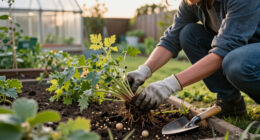
For a nursery plant with circling roots, the report recommends inspecting the root system before planting, loosening the surrounding soil and gently spreading healthy roots outward. It says a hand cultivator can help loosen roots, while large, tight roots may need to be cut. The report associates roots left in a circular pattern with stunted growth, reduced nutrient access and possible trunk girdling, in which roots press around the trunk.
To avoid planting too deeply, locate the root flare—the point where the trunk widens into the roots—and leave it visible at or slightly above the soil line. The report advises digging a hole about twice as wide as the root ball, but no deeper, and setting the plant on firm soil so it is less likely to sink. After planting, water thoroughly and check the soil near the root ball regularly. Water slowly and deeply when it is drying out, but wait if it remains wet. For mulch, use a two- to three-inch layer across the root zone, keeping it several inches from the trunk.
How Planting Errors Affect Establishment
The four mistakes concern different parts of early establishment: root direction, planting depth, moisture and trunk protection. Addressing them when planting can help gardeners avoid preventable stress and spot problems that might otherwise be hidden under soil or mulch. The report says circling roots can continue growing in a tight pattern, and that roots growing around a trunk may constrict it. It also warns that buried root flares and bark kept wet by mulch can create conditions associated with decay and other difficulties.
The practical point for homeowners is that planting is not finished once a tree or shrub is in the ground. Newly planted roots need appropriate moisture, but soil should not remain waterlogged. Mulch can help cover the root zone, yet a mound pressed against bark can trap moisture and hide the root flare. The recommendations are intended to help gardeners balance those needs rather than apply a fixed watering routine or pile on more mulch.
The source does not claim that every planting error will cause lasting damage, nor does it give a time estimate for recovery. Outcomes can depend on the plant and conditions at the site. Its warning is that plants may appear fine initially even as problems develop below ground, making attention during planting and establishment useful.
Products Worth Considering

AMERLIFE 34 x 10 x 7 ft Walk-In Tunnel Greenhouse with Watering System

Traeger Pro 22 Wood Pellet Grill and Smoker, 572 sq. in.

Weber Searwood 600 Wood Pellet Smoker Grill, Black
As an affiliate, we earn on qualifying purchases.
Fall Conditions and Root Care
The report frames fall as a potentially favorable planting season: cooler air and warm soil can make planting manageable and give roots time to settle before winter. That seasonal advantage does not remove the need to check the plant’s root system or the planting hole. The article does not compare fall planting with spring planting or prescribe dates for particular climates, so its seasonal guidance should not be read as a universal calendar.
Its recommendations focus on observable checks rather than a single recipe. Before planting, gardeners can look for roots circling inside a nursery pot and find the root flare by clearing away surface soil and mulch near the trunk. After planting, they can assess moisture by checking soil near the root ball instead of assuming rainfall has provided enough water. The report describes mulch as a layer over the root zone, not a mound against the trunk.
“The goal is moist soil, not waterlogged soil.”
— Country Living report
What the Report Does Not Establish
The source offers gardening recommendations, but it does not cite a study, report measured outcomes or quantify the likelihood that any one mistake will lead to long-term harm. It also does not provide guidance tailored to particular tree species, soil types, climates or local planting dates. The effects described should be understood as risks the report associates with these practices, not as a prediction that every affected plant will decline.
The report gives no specific watering volume or interval because it advises checking soil moisture instead. It also does not set out a detailed assessment for deciding which roots are safe to cut. Gardeners facing severe root damage, unusual site conditions or a struggling established plant may need advice specific to that plant and location.
Checks to Make After Planting
For a newly planted tree or shrub, the report’s next steps are to keep the root flare visible, inspect soil moisture near the root ball and water slowly when that area is drying. Gardeners should keep mulch shallow and several inches away from the trunk, and avoid assuming that rain alone is enough. These checks should continue while the plant’s roots establish.
The source does not name a follow-up date, monitoring period or later milestone. It also does not announce additional reporting or a new program. Its advice is to respond to the plant and soil conditions: wait when the soil is still wet, and water when it is drying, while keeping the trunk and root flare clear of piled mulch.
Key Questions
What four fall planting mistakes does the report identify?
It lists leaving circling roots untreated, planting too deeply, insufficient watering during establishment and piling mulch against the trunk.
How can I tell whether a tree is planted too deeply?
Look for the root flare, where the trunk widens into the roots. The report says it should remain visible at or slightly above the soil line.
How often should a newly planted tree be watered?
The report does not give a fixed schedule. Check soil near the root ball: water slowly and deeply when it is drying, and wait if it is still wet. The aim is moist, not waterlogged, soil.
How should mulch be placed around a new tree?
Spread a two- to three-inch layer over the root zone and leave several inches between the mulch and the trunk. Keep the root flare visible and do not let mulch touch the bark.
Should circling roots be cut before planting?
The report recommends loosening and spreading healthy roots outward. It says large, tight, problematic roots may need to be cut, but it does not provide a species-specific cutting guide.
Source: countryliving.com