
By keeping detailed records of your watering, pest control, and environmental conditions, you can make immediate adjustments that boost plant health and resource efficiency. Tracking these details helps you spot patterns, prevent issues, and fine-tune practices on the spot. This proactive approach guarantees healthier plants and better yields. If you want to learn how to optimize your greenhouse operations further, there’s more to discover that can help you succeed.
Get ready for Prime Big Deal Days — try Prime free
Exclusive member deals on October 6–7, plus fast free delivery. Cancel anytime.
As an affiliate, we earn on qualifying purchases.
Key Takeaways
- Provides immediate insights into plant responses, enabling quick adjustments to improve growth conditions.
- Detects patterns and issues early, preventing minor problems from escalating.
- Ensures consistent practices, reducing errors and variability in plant care.
- Facilitates rapid evaluation of treatment effectiveness for watering and pest control.
- Enhances decision-making accuracy by offering clear, data-driven information.
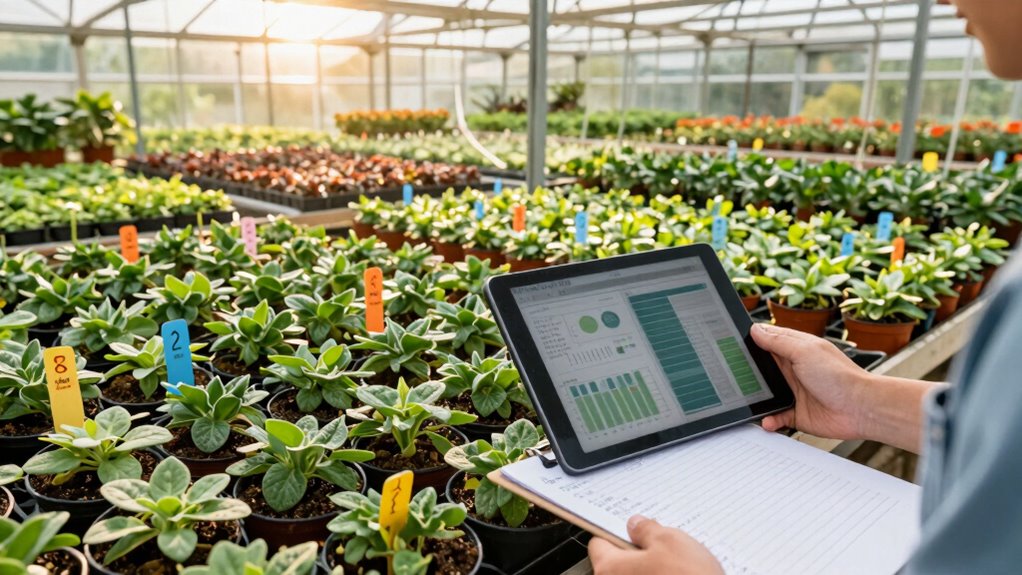
Have you ever wondered how some greenhouse growers consistently improve their results? The secret often lies in their meticulous record-keeping. When you keep detailed logs of your activities, like watering schedules and pest management efforts, you gain a clearer picture of what’s working and what’s not. Records allow you to track patterns over time, helping you identify the best times to water your plants or when pest issues tend to arise. Without this information, you’re fundamentally flying blind, reacting to problems rather than preventing them.
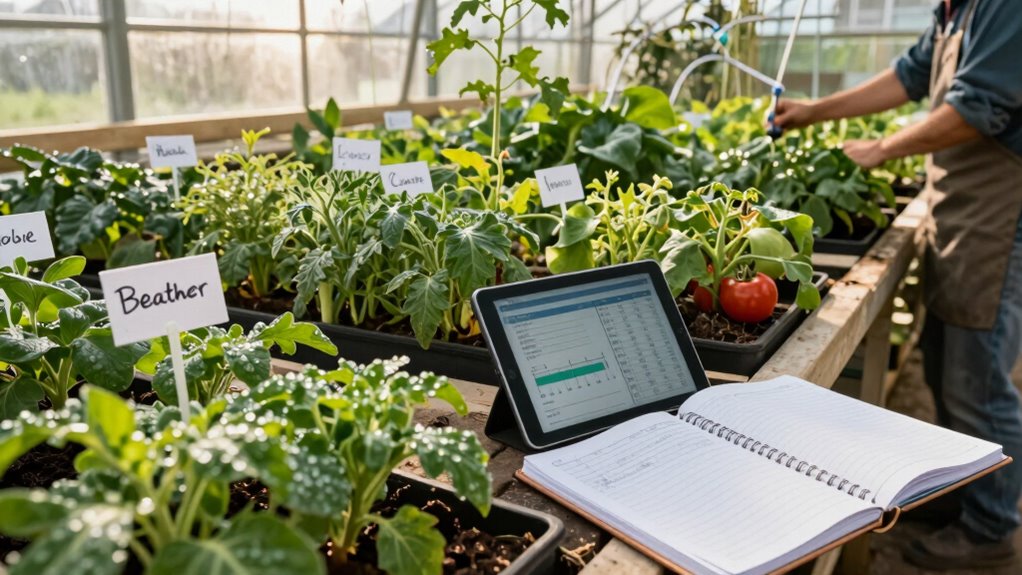
By documenting your watering schedules, you guarantee that your plants receive consistent and appropriate moisture. Overwatering can lead to root rot, while underwatering stunts growth. When you record each watering, including date, time, and amount, you develop a reliable routine. Over time, this helps you fine-tune your watering practices, avoiding guesswork and reducing waste. Plus, if you notice a decline in plant health, you can immediately review your logs to see if watering inconsistencies might be the cause. This proactive approach saves you time and resources while boosting plant vitality.
Recording your watering details ensures consistent moisture, helps prevent over- or underwatering, and improves plant health over time.
Similarly, thorough pest management records are crucial. When you document every pest control measure—what products you used, application dates, and pest sightings—you create an extensive history. This history makes it easier to recognize recurring pest issues and to evaluate the effectiveness of your strategies. If a particular treatment didn’t eliminate the problem, your records show it, prompting you to adjust your approach. Consistent documentation also helps you stay compliant with safety guidelines and product labels, reducing the risk of misuse or over-application.
Better record-keeping isn’t just about fixing problems; it’s about optimizing your entire greenhouse operation. When you analyze your logs regularly, you can identify trends and make data-driven decisions. For example, you might notice that certain plants respond better to specific watering times or that pest outbreaks happen after particular environmental conditions. This insight lets you implement preventative measures, rather than constantly playing catch-up. Additionally, understanding environmental factors helps you anticipate potential issues and act proactively, which is a key aspect of successful greenhouse management. Developing a comprehensive record system can significantly enhance your ability to make informed choices and improve results over time.
Maintaining detailed records also cultivates a greater understanding of how your growing environment influences plant health and productivity. Incorporating air quality and ventilation data into your logs can help you identify how these factors impact your crops and make necessary adjustments. In short, improving your record-keeping practices instantly enhances your ability to manage your greenhouse effectively. It transforms guesswork into informed action, making your watering schedules more precise and pest management more effective. As a result, your plants thrive, your resources are used more efficiently, and your overall results improve. It’s a simple step with powerful benefits—start logging today, and watch your greenhouse succeed like never before.
As an affiliate, we earn on qualifying purchases.
Frequently Asked Questions
How Often Should Greenhouse Records Be Updated for Best Results?
You should update your greenhouse records daily to optimize climate control and support plant growth. Daily updates help you monitor temperature, humidity, and light levels, allowing quick adjustments for ideal conditions. Regularly recording these data points guarantees you catch issues early, maintain consistent environments, and enhance plant health. Consistent record-keeping empowers you to make informed decisions that improve greenhouse results and boost overall crop yield.
What Digital Tools Are Recommended for Greenhouse Record-Keeping?
Think of your greenhouse as a ship steering through data-driven waters. Digital tools like FarmLogs or Tetra Tech act as your compass, offering digital integration and real-time data visualization. They help you track temperature, humidity, and plant growth effortlessly. By choosing these tools, you can steer your greenhouse more precisely, make informed decisions faster, and optimize your results with clarity and confidence.
How Do I Train Staff to Maintain Accurate Records?
You train staff by emphasizing the importance of record accuracy through clear, hands-on employee training sessions. Show them how to input data correctly and regularly review records together to catch errors early. Use practical examples and step-by-step guides to reinforce best practices. Encourage questions and ongoing learning, fostering a culture that values precise record-keeping, which directly impacts greenhouse efficiency and plant health.
Can Record-Keeping Help Identify Pest or Disease Outbreaks Early?
Think of your records as a vigilant lighthouse, guiding you through foggy waters. With diligent pest detection and disease monitoring, you spot trouble early—like spotting a shadow before it becomes a storm. Accurate records reveal subtle changes in plant health, helping you catch pest or disease outbreaks at their infancy. This early detection allows swift action, saving your crops from severe damage and keeping your greenhouse thriving.
What Are Common Mistakes to Avoid in Greenhouse Record Management?
You should avoid common mistakes like neglecting data accuracy and disorganized storage. Make certain your records are precise and consistently updated to prevent errors that can skew your analysis. Keep your data well-organized by using clear labels and secure storage systems, so you can quickly access essential information. These practices help you make informed decisions, catch issues early, and improve overall greenhouse performance efficiently.
Conclusion
So, next time your greenhouse isn’t thriving, don’t blame the weather or your luck—just check your records. Ironically, the one thing that could instantly boost your results is something you’ve probably been ignoring. Good record-keeping might seem tedious, but it’s the secret weapon you’re missing. Remember, sometimes the simplest solutions are right in front of you—hidden in your own data, waiting to turn your green dreams into reality.
Fall yard work Picks
leaf blowers
As an affiliate, we earn on qualifying purchases.