Choosing a garden greenhouse kit often comes down to whether you want a structure to keep for years or an inexpensive way to extend the growing season. Polycarbonate kits use rigid panels on a frame; plastic-film kits stretch a flexible cover over a frame, often made of metal or plastic. That construction difference affects price, wind stability, upkeep, and how well the greenhouse holds up over time.

Get garden gear delivered free with Prime
- Fast, free delivery on millions of items
- Prime Video, Amazon Music and more included
- Member-only deals all year
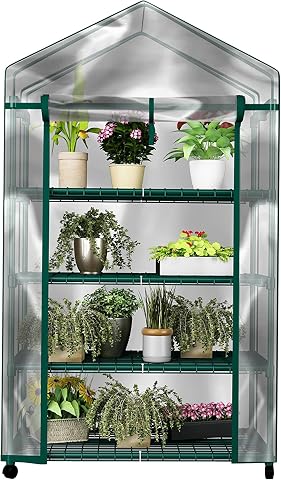
Pure Garden 4-Tier Mini Greenhouse with Locking Wheels and PVC Cover
- ✔ Dimensions: 27.1 × 19.3 × 63.3 in
- ✔ Shelves: 4 tiers
- ✔ Shelf width: 27 in

VEVOR Walk-In Tunnel Greenhouse, 14.6 × 6.4 × 6.3 ft
- ✔ Dimensions: 14.6 × 6.4 × 6.3 ft
- ✔ Frame: Galvanized steel
- ✔ Pole diameter: 1 in

Garvee 6 × 8 ft Walk-In Polycarbonate Greenhouse with Aluminum Frame
- ✔ Dimensions: 6 × 8 ft
- ✔ Panels: UV-blocking polycarbonate
- ✔ Frame: Reinforced matte aluminum
Polycarbonate is usually the stronger fit for gardeners who want a more permanent structure and can spend more upfront. Plastic film suits seasonal growers, renters, and anyone who wants to protect seedlings without committing to a costly build. Neither material guarantees good performance on its own: frame strength, anchoring, ventilation, panel or film quality, and local weather all matter.
At a Glance
| Criteria | Polycarbonate greenhouse kits | Plastic-film greenhouse kits | Winner |
|---|---|---|---|
| Upfront cost | Usually higher; rigid panels and frames add cost | Usually lower; a practical entry point | B |
| Durability | Rigid panels can last for years, depending on quality and exposure | Film can tear, stretch, or degrade and often needs replacement | A |
| Wind and snow stability | Often better when the frame, anchoring, and panels are rated for local conditions | More vulnerable to wind damage; snow can collect or strain the frame | A |
| Light and insulation | Diffused light and some insulation; performance varies by panel design | Lightweight cover provides limited insulation; light transmission varies | Depends |
| Setup and portability | More involved assembly; generally intended to stay in one place | Often simpler and lighter to assemble, move, or dismantle | B |
| Maintenance and replacement | Panels may need cleaning or replacement after damage | Cover tension and condition need checks; replacement film is a recurring cost | Depends |
| Long-term value | Better for regular, multi-season use if the kit suits the climate | Better for short-term or occasional use when low initial spend matters | Depends |
Pure Garden 4-Tier Mini Greenhouse with Locking Wheels and PVC Cover
For gardeners with a small patio, balcony, or sheltered corner, the Pure Garden 4-Tier Mini Greenhouse makes vertical space do the work. Its four shelves provide separate levels for plants, trays, and supplies, while the 27.1 × 19.3 in footprint is far easier to accommodate than either walk-in kit in this roundup. That compact format also changes the growing experience: we can tend plants from outside the unit, rather than stepping into a dedicated structure.The locking wheels are its clearest advantage over VEVOR and Garvee. We can reposition the shelving to catch light or move it out of the way, then lock it in place. A zippered roll-up door gives access and helps shield plants from pests and frost, though a PVC cover is a flexible barrier, not a rigid greenhouse panel. Compared with Garvee’s adjustable roof vent, its ventilation approach is simpler and centered on opening the front door.Each shelf supports up to 24 lb, which is useful for ordinary pots and trays but calls for attention when grouping heavy containers. This is not the pick for in-ground beds, tall plants that need walk-in clearance, or anyone seeking a larger permanent structure. We rank it first for compact gardens because its mobility, tiered capacity, and tool-free assembly address the needs of that buyer directly; for a larger growing area, VEVOR is the more appropriate step up.
Pros:
- Four tiers organize plants, trays, and gardening supplies in a small footprint.
- Locking wheels make it possible to reposition the unit and keep it stationary.
- Zippered roll-up door provides convenient access to the shelves.
- Tool-free assembly reduces setup steps.
Cons:
- Each shelf has a 24 lb weight limit, so heavy pots need to be distributed carefully.
- The PVC cover is flexible and offers less structure than Garvee’s polycarbonate panels.
Best for: Gardeners who need a movable, vertical plant shelter for a patio, balcony, or small sheltered growing area.
Not ideal for: Buyers who need walk-in access, space for beds, or a rigid-panel structure with a dedicated roof vent.
Bottom line: Choose the Pure Garden when compact, movable shelving matters more than walk-in growing space or rigid panels.
“Choose the Pure Garden when compact, movable shelving matters more than walk-in growing space or rigid panels.”
VEVOR Walk-In Tunnel Greenhouse, 14.6 × 6.4 × 6.3 ft
When a compact shelf unit is no longer enough, the VEVOR Walk-In Tunnel Greenhouse provides a substantially larger area for tending plants from inside. At 14.6 × 6.4 × 6.3 ft, it has the greatest stated footprint in this lineup, making it the clearest choice for gardeners with outdoor room who want access to a broader growing area. Its scale is the main reason to choose it over the Pure Garden, whose four shelves serve containers rather than a walk-in layout.VEVOR uses a galvanized steel frame and a 140 g/m² PE cover with double-stitched seams and reinforced window seams. Eight mesh windows and a roll-up zipper door help balance access with airflow. Extended cover edges can be weighted down or buried, while stakes and tie-downs add ways to secure the structure. Those details distinguish it from a minimal covered frame, but the enclosure is still flexible plastic; Garvee is the better fit if rigid polycarbonate panels are a priority.We give VEVOR the growing-space role because it combines walk-in access with multiple ventilation openings and a large tunnel footprint. The tradeoff is that its size requires outdoor space for setup, and the included plastic cover has a different feel from a framed panel greenhouse. Buyers should consider where it will sit and how they will secure it before choosing a kit of this scale. If space is limited, Pure Garden is more manageable; if the priority is a more structured panel enclosure, Garvee is the stronger match.
Pros:
- Largest footprint in this comparison provides room to walk among plants.
- Eight mesh windows and a roll-up door support airflow and access.
- Galvanized steel frame includes reinforced poles, diagonal bars, stakes, and tie-downs.
- Extended cover edges can be weighted down or buried.
Cons:
- The PE cover is flexible plastic rather than rigid greenhouse panels.
- Its walk-in size requires a dedicated outdoor setup area.
Best for: Gardeners with outdoor space who want a large walk-in growing area and several mesh ventilation openings.
Not ideal for: Small-space growers or buyers who want a rigid polycarbonate enclosure rather than a flexible plastic cover.
Bottom line: Pick VEVOR when walk-in room and a broad tunnel footprint matter more than rigid panels or a compact setup.
“Pick VEVOR when walk-in room and a broad tunnel footprint matter more than rigid panels or a compact setup.”
Garvee 6 × 8 ft Walk-In Polycarbonate Greenhouse with Aluminum Frame
The Garvee 6 × 8 ft Walk-In Polycarbonate Greenhouse is the most structured option here. Its UV-blocking polycarbonate panels sit in a reinforced matte aluminum frame, creating a different kind of enclosure from VEVOR’s PE-covered tunnel and the Pure Garden’s PVC-covered shelving. For buyers who want a defined walk-in greenhouse with rigid panels, Garvee is the clearest match in this group.Ventilation and water management are part of its appeal. An adjustable roof vent lets growers manage airflow from above, while the lockable outward-opening door supports access and security. The integrated rain gutter and drainage channel direct runoff away and can connect to a hose, a useful detail for gardeners who want to collect or guide water. Ground anchors and mid-post supports are included, and the listed snow-load capacity is over 110 lb/sq ft. These features set it apart from the more open-ended tunnel setup, though a specification alone cannot account for every site’s exposure or installation conditions.Garvee ranks as our premium-style panel pick because it combines rigid cladding with a frame, vent, door, and drainage features in a 6 × 8 ft footprint. It is smaller than VEVOR’s tunnel by stated floor area, so gardeners prioritizing maximum room should look there instead. Assembly also requires handling pre-labeled parts and following the instructions, and the product ships in two boxes. We would choose it for a more defined panel greenhouse setup, while a buyer seeking simple movable shelving is better served by Pure Garden.
Pros:
- Polycarbonate panels have a UV-blocking coating and allow beneficial sunlight through.
- Adjustable roof vent and lockable outward-opening door support airflow control and access.
- Integrated gutter and drainage channel direct rainwater and can connect to a hose.
- Ground anchors and mid-post supports are included.
Cons:
- Assembly involves handling labeled parts and following the included instructions.
- The greenhouse ships in two separate boxes.
Best for: Gardeners who want a walk-in greenhouse with rigid polycarbonate panels, adjustable roof ventilation, and integrated rain drainage.
Not ideal for: Buyers who need the largest possible walk-in footprint or prefer a quick, highly portable shelving kit.
Bottom line: Choose Garvee for a more structured rigid-panel greenhouse with roof ventilation and rainwater management.
“Choose Garvee for a more structured rigid-panel greenhouse with roof ventilation and rainwater management.”
As an Amazon Associate we earn from qualifying purchases.
Key Differences
The central tradeoff is upfront cost versus service life and stability. Film kits are easier to buy on a tight budget, and their lighter construction can be useful for seasonal growing or a temporary garden setup. That low purchase price can lose its appeal if the cover needs frequent replacement or a storm damages the frame. Polycarbonate generally asks for more money and assembly at the start, then offers a more substantial structure for repeated use.
Climate and placement can change the decision. A sheltered backyard used mainly for spring seedlings may be well served by a film kit. An exposed site, a longer growing season, or frequent use makes frame strength, anchoring, ventilation, and panel quality more important. Polycarbonate is not automatically storm-proof or warm enough for winter production; check the kit’s ratings and construction against local wind and snow conditions.
For value, count the cost of replacement covers, anchoring, repairs, and any seasonal dismantling alongside the initial price. A well-matched film kit can be the better buy for occasional use. If the greenhouse will stay up and serve you year after year, a suitably rated polycarbonate kit is usually the more sensible investment.
Detailed Comparison
Upfront cost (Plastic-film greenhouse kits wins — major)
Plastic-film kits usually win on purchase price, making them easier to try without a large investment. Polycarbonate costs more because it uses rigid panels and often a more substantial frame. The gap is major for budget-conscious buyers: choose film if the priority is getting basic coverage for less, but compare replacement-cover costs before treating the initial price as the full expense.
Durability (Polycarbonate greenhouse kits wins — major)
Polycarbonate wins by a major margin in typical use. Rigid panels are less prone to the tearing and stretching that can affect film, though panel quality, UV exposure, and frame construction still matter. Film is easier to replace, but it is also a wear item. For a greenhouse expected to stay in place across many seasons, polycarbonate is usually the safer choice.
Wind and snow stability (Polycarbonate greenhouse kits wins — moderate)
Polycarbonate kits generally have an advantage because rigid panels and stronger frames can create a more stable structure. The difference is moderate to major, depending on the models and site. A cheap panel kit may still perform poorly in harsh weather, and film can be vulnerable to gusts or snow loading. Check the manufacturer’s wind and snow guidance, secure the greenhouse to a suitable base, and avoid assuming either kit is safe for severe conditions.
Light and insulation (moderate difference)
This is a model-dependent tradeoff rather than a universal win. Polycarbonate can diffuse sunlight and provide more insulation than a single film layer, but panel thickness and design vary. Film can transmit plenty of light, yet usually provides less insulation unless the kit uses specialized or multiple layers. Compare light transmission and insulation details for the specific kits; for winter growing, neither material replaces suitable heating and climate control.
Setup and portability (Plastic-film greenhouse kits wins — moderate)
Film kits usually win for lighter handling and seasonal flexibility. Their frames and covers can be easier to move or dismantle, though fitting and tensioning the cover takes care. Polycarbonate assembly can be more involved, and once built, the structure is less convenient to relocate. This is a moderate difference for renters or gardeners who store equipment between seasons, and a minor one for anyone with a permanent site.
Maintenance and replacement (moderate difference)
There is no outright winner across all models. Film requires inspection for tears, loose fittings, and loss of tension; replacement covers may be inexpensive but recurring. Polycarbonate avoids routine cover replacement in many cases, but panels can crack, loosen, or need cleaning. The practical difference is moderate: check whether replacement parts are available for the specific kit and whether you are comfortable with periodic repairs.
Long-term value (major difference)
Polycarbonate usually wins for frequent, multi-year use, provided the kit is well built and suitable for the site. Its higher upfront cost can make sense when it avoids repeated cover purchases and provides a more stable workspace. Film can be better value for a short-term project or occasional seed starting, where paying for a permanent structure would be unnecessary. The winner depends on how often you will use it and how long you expect to keep it.
Polycarbonate greenhouse kits: Pros and Cons
Pros:
- More substantial structure for repeated, multi-season use
- Rigid panels are less likely than film to tear or stretch
- Often provides better insulation than a single-layer film cover
- Can be a better long-term investment when properly matched to the site
Cons:
- Higher upfront cost
- Assembly can take more time and care
- Less convenient to move or store seasonally
- Panel and frame ratings still need to match local weather
Plastic-film greenhouse kits: Pros and Cons
Pros:
- Lower initial price
- Lightweight and often easier to move or dismantle
- Useful for seasonal growing and basic seedling protection
- A damaged cover may be simpler to replace than rigid panels
Cons:
- Film can tear, stretch, or degrade and may need replacement
- Often less stable in strong wind or under snow load
- Typically offers less insulation than rigid multiwall panels
- Recurring cover costs can reduce savings over time
Who Should Choose What
Choose Polycarbonate greenhouse kits if:
- You expect to use the greenhouse for several seasons or longer.
- The structure will stay in one place and you can assemble and anchor it properly.
- Your budget allows a higher initial purchase for a more durable setup.
- The kit’s frame and panel ratings suit your local wind and snow conditions.
Choose Plastic-film greenhouse kits if:
- You want affordable protection for seedlings or seasonal crops.
- You rent, have limited space, or may dismantle the greenhouse later.
- You prefer a low initial cost and accept that the cover may need replacement.
- Your site is sheltered and the kit’s frame is suitable for your intended use.
Skip both if: Skip these kits if your site faces severe weather and neither model is rated for it, or if you need dependable heated, year-round production that requires a properly engineered structure and dedicated climate controls.
Value for Money
Paying more for polycarbonate is worth it when the greenhouse will be used regularly over several years, especially if a film cover would need repeated replacement. Its value depends on the full kit: frame quality, anchoring options, replacement-panel availability, and suitability for local weather. A higher price alone does not guarantee a better structure.
For one or two growing seasons, occasional seed starting, or a sheltered garden, a film kit can deliver better value by keeping the initial commitment low. Add the cost of replacement film and repairs to your estimate if you plan to keep it longer. Buy polycarbonate for sustained use; buy film when flexibility and low upfront spend matter more than a long service life.
Final Verdict
For most gardeners planning regular, multi-season use, choose a well-built polycarbonate kit with frame and weather ratings that match the site. It costs more upfront, but its rigid panels and sturdier construction generally make it the better long-term purchase. Choose a plastic-film kit for seasonal growing, a sheltered location, or a tight budget where easy setup and low initial cost matter more than longevity.
The biggest deciding factor is how long the greenhouse will stay in use and how exposed its location is. If neither kit is rated for local wind or snow, skip both and look for a structure designed for those conditions.
Frequently Asked Questions
Are polycarbonate greenhouse kits worth the extra cost?
Often, if you will use the greenhouse regularly for several years. Rigid panels can avoid some of the recurring cover costs associated with film. For occasional or short-term use, the lower price of a film kit may offer better value.
Which greenhouse kit is better for windy areas?
A properly rated polycarbonate kit is usually the better starting point, but the frame, anchoring, and installation matter as much as the panel material. Check the manufacturer’s wind guidance and secure the structure to a suitable base.
Can a plastic-film greenhouse stay up all year?
Some can, but suitability depends on the frame, cover, anchoring, and local weather. Wind, UV exposure, and snow can shorten the cover’s life or damage the structure. Follow the kit’s seasonal and weather guidance.
Does polycarbonate keep a greenhouse warm in winter?
It can reduce heat loss compared with a single film layer, particularly in multiwall designs, but it does not provide reliable winter warmth by itself. Cold-season growing may require insulation, ventilation management, and heating.