The best grow light meters help you measure the light reaching your plants, rather than relying on fixture wattage or phone apps. My best overall pick is the Apogee MQ-500, a focused choice for growers who want full-spectrum PAR readings; the DANOPLUS Quantum PAR Meter is a simpler alternative, while the Landtek 3-in-1 adds UVA and infrared readings. The main tradeoff is between a dedicated PAR meter’s focused measurements and broader features, portability, or lower-cost simplicity. Sensor access and how you plan to sample light across a canopy also affect which meter will be practical. Read on for how these seven options differ and which type of grower each one suits.

Get garden gear delivered free with Prime
- Fast, free delivery on millions of items
- Prime Video, Amazon Music and more included
- Member-only deals all year
Complete the kit


Key Takeaways
- The Apogee MQ-500 is the focused pick: it leads this comparison for growers prioritizing full-spectrum PAR measurement over extra light categories.
- The AM-330 wand changes the handling equation, not the measurement goal: the MQ-500 bundle suits hard-to-reach canopy points better than the standard meter.
- Extra readings are useful only when they match your setup: Landtek’s UVA and IR measurements may help with broader light checks, but are not a substitute for a suitable PAR reading.
- The lineup divides between dedicated PAR tools and simpler handheld meters: DANOPLUS and the two broadly named Quantum PAR options put the emphasis on 400–700 nm readings.
- Sensor placement matters as much as the feature list: a split sensor, such as the YOWEXA’s, can make readings easier in cramped spaces, while a basic handheld design may be less convenient over dense plants.
| Apogee MQ-500 Full-Spectrum Quantum PAR Meter | 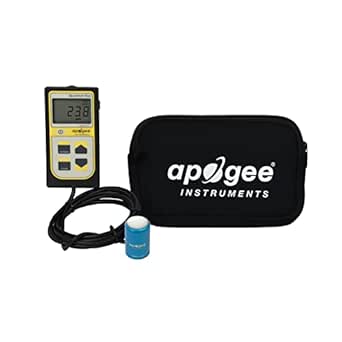 | Best Overall | Wavelength range: 400–700 nm | Measurement modes: Instantaneous and logged | Sensor material: Machined aluminum | VIEW LATEST PRICE | See Our Full Breakdown |
| DANOPLUS Quantum PAR Meter, 400–700 nm | 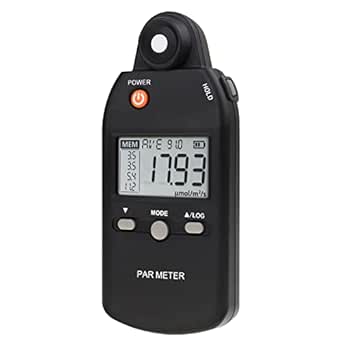 | Best for Repeatable Light Mapping | Measurement range: 0–5,000 μmol/m²/s | Wavelength range: 400–700 nm | Wavelength tolerance: ±10 nm | VIEW LATEST PRICE | See Our Full Breakdown |
| Landtek 3-in-1 PAR Meter for PPFD, UVA, and IR Light |  | Best for Multi-Band Light Checks | Spectral range: 320–800 nm | PPFD range: 0–5,000 µmol/m²·s | Measurement modes: PPFD, UVA, IR, and separate red, green, and blue readings | VIEW LATEST PRICE | See Our Full Breakdown |
| YOWEXA Digital Light Meter with Split Sensor |  | Best for Basic Lux Checks | Illuminance range: 0–200,000 lux; 0–20,000 foot-candles | Resolution: 0.1 lux | Measurement rate: 2 readings per second | VIEW LATEST PRICE | See Our Full Breakdown |
| AH-Quantuv PAR and UVA Meter for Grow Lights |  | Best for PAR and UVA in One Meter | PAR measurement range: 400–750 nm | UVA measurement range: 320–400 nm | Recording capacity: Up to 100 PAR measurements | VIEW LATEST PRICE | See Our Full Breakdown |
| Apogee MQ-500 Full-Spectrum Quantum PAR Meter with AM-330 Telescopic Wand |  | Best for Reaching Over Plant Canopies | Wavelength range: 400–700 nm | Measurement modes: Instantaneous and logged | Sensor: Waterproof, fully potted machined-aluminum head | VIEW LATEST PRICE | See Our Full Breakdown |
| Quantum PAR Meter for LED Grow Lights, 400–700 nm |  | Best for Recording and Comparing Readings | Measurement: Photosynthetic photon flux density (PPFD) | Measurement range: 0–5000 μmol/m²/s | Wavelength range: 400–700 nm | VIEW LATEST PRICE | See Our Full Breakdown |
| grow light meter | Wavelength range | Model |
|---|---|---|
| Apogee MQ-500 Full-Spectrum Qu | 400–700 nm | — |
| DANOPLUS Quantum PAR Meter | 400–700 nm | DP-355 |
| Landtek 3-in-1 PAR Meter for P | — | MILA53000 |
| YOWEXA Digital Light Meter wit | — | — |
| AH-Quantuv PAR and UVA Meter f | — | AH-Quantuv |
| Apogee MQ-500 Full-Spectrum Qu | 400–700 nm | — |
| Quantum PAR Meter for LED Grow | 400–700 nm | PAR-355 |
More Details on Our Top Picks
Apogee MQ-500 Full-Spectrum Quantum PAR Meter
The Apogee MQ-500 is my strongest all-around pick for growers who want direct PPFD readings rather than a general-purpose light estimate. Its 400–700 nm range targets the photosynthetically active band, and it supports both instantaneous checks and logged measurements, making it useful for comparing spots or tracking a grow area over time. Compared with the DANOPLUS Quantum PAR Meter, the MQ-500 emphasizes a waterproof, fully potted aluminum sensor and a four-year warranty, while the DANOPLUS lists a specific 0–5,000 μmol/m²/s range and memory for 100 readings. The tradeoff is that the supplied details do not specify a measurement range or memory capacity for the Apogee, and it requires a lithium metal battery. I’d choose it for durable, focused PAR monitoring, not for extra UVA or RGB data.
Pros:- Measures photosynthetic photon flux density across the 400–700 nm range.
- Offers instantaneous and logged measurement modes.
- Waterproof, fully potted sensor with machined aluminum construction.
- Long tangle-free cable, high-contrast display, and four-year warranty.
Cons:- Requires a lithium metal battery.
- The supplied product data does not state a measurement range or logging capacity.
- Does not provide the UVA and separate RGB readings offered by the Landtek and AH-Quantuv.
Best for: Indoor growers and horticulture professionals who want a dedicated PPFD meter with a rugged sensor and both live and logged readings.
Not ideal for: Growers who need stated measurement limits, extensive onboard reading storage, or UVA and separate RGB measurements.
- Wavelength range:400–700 nm
- Measurement modes:Instantaneous and logged
- Sensor material:Machined aluminum
- Sensor protection:Waterproof and fully potted
- Cable:Tangle-free
- Item weight:6.4 ounces
- Battery:1 lithium metal battery, included
- Warranty:4 years
Our verdict“Choose the MQ-500 for durable, dedicated PAR monitoring, but pick the DANOPLUS if a clearly stated range and 100-reading memory matter more.”
DANOPLUS Quantum PAR Meter, 400–700 nm
The DANOPLUS Quantum PAR Meter suits growers who want a defined measurement range and a practical way to compare multiple points under a fixture. It reads 0–5,000 μmol/m²/s, stores up to 100 measurements, and keeps the four latest visible—handy when checking whether light is even across a canopy. Its tripod socket also allows stable positioning, unlike a purely handheld approach, though the tripod itself is not included. Compared with the Apogee MQ-500, DANOPLUS gives more explicit range and memory details; the Apogee counters with a waterproof, fully potted sensor and a longer stated warranty. DANOPLUS lists ±10 nm wavelength tolerance, so buyers seeking the most confidence from spectral specifications should weigh that limitation. This is a focused mapping tool, not a meter for UVA or RGB breakdowns.
Pros:- Measures PPFD from 0 to 5,000 μmol/m²/s across 400–700 nm.
- Stores up to 100 measurements and displays the four most recent.
- Tripod socket supports stable readings at repeatable positions.
- Portable 8.8-ounce design for moving between growing areas.
Cons:- Tripod is not included.
- Wavelength tolerance is ±10 nm.
- Does not measure UVA or provide separate RGB readings like the Landtek or AH-Quantuv.
Best for: Home growers who map PPFD across a grow tent or bench and want onboard storage for comparing readings.
Not ideal for: Buyers who need a supplied tripod, UVA or RGB measurements, or a waterproof sensor with a stated multi-year warranty.
- Measurement range:0–5,000 μmol/m²/s
- Wavelength range:400–700 nm
- Wavelength tolerance:±10 nm
- Memory:Up to 100 measurements
- Display:Shows the four most recent measurements
- Tripod socket:Yes; tripod not included
- Item weight:8.8 ounces
- Model:DP-355
Our verdict“Pick DANOPLUS for organized PPFD mapping with specified range and memory, and favor the Apogee MQ-500 if sensor protection is the priority.”
Landtek 3-in-1 PAR Meter for PPFD, UVA, and IR Light
The Landtek 3-in-1 is the most versatile choice here for growers who want more than a standard PAR reading. Along with PPFD, it measures UVA and infrared, and its separate red, green, and blue readings can help users compare the light mix from different fixtures. MAX, MIN, average, and real-time recording functions add useful context when readings fluctuate, though storage is limited to 30 records. That is less than the 100-reading capacity of both the DANOPLUS and AH-Quantuv. Its 320–800 nm spectral range is also broader than the dedicated 400–700 nm coverage of the Apogee MQ-500, but the listed ±10 nm wavelength tolerance remains a qualification for users who need tight spectral precision. Choose Landtek for breadth of data, not the simplest PAR-only workflow.
Pros:- Measures PPFD, UVA, and infrared across a 320–800 nm spectral range.
- Provides separate red, green, and blue readings.
- Calculates MAX, MIN, and average values and supports real-time recording.
- Can be handheld or mounted using its built-in tripod socket.
Cons:- Stores only 30 records, fewer than the DANOPLUS and AH-Quantuv.
- Tripod is not included.
- Wavelength tolerance is ±10 nm.
Best for: Growers comparing fixtures or plant areas who want PPFD alongside UVA, infrared, and separate RGB readings.
Not ideal for: Users who only need straightforward PAR readings, want more than 30 stored records, or require a supplied tripod.
- Spectral range:320–800 nm
- PPFD range:0–5,000 µmol/m²·s
- Measurement modes:PPFD, UVA, IR, and separate red, green, and blue readings
- Wavelength tolerance:±10 nm
- Data functions:MAX, MIN, average, real-time recording, and storage for 30 records
- Mounting:Built-in tripod socket; tripod not included
- Power:2 AAA batteries, included
- Model:MILA53000
Our verdict“Choose Landtek when UVA, IR, and RGB information matter more than large storage capacity or a simple PAR-only interface.”
YOWEXA Digital Light Meter with Split Sensor
The YOWEXA Digital Light Meter is the outlier in this roundup: it measures illuminance in lux or foot-candles, not PPFD. That makes it useful for checking relative brightness or routine lighting conditions, but it is not a direct substitute for the Apogee MQ-500 or DANOPLUS when a grower needs photosynthetic photon flux density. Its split sensor probe lets the user position the detector while keeping the display in view, and the meter adds temperature readings plus Hold and Max/Min functions. Compared with the PAR-focused Landtek, YOWEXA is simpler for general illuminance checks but lacks UVA, IR, and RGB data. Stored readings are cleared when the unit powers off, so its 60-reading memory is best for short sessions rather than ongoing records.
Pros:- Separate sensor probe allows flexible positioning while keeping the display accessible.
- Measures illuminance in lux and foot-candles, with a stated resolution of 0.1 lux.
- Displays ambient temperature in °C or °F.
- Offers Hold, Max/Min, average, backlight, and storage for up to 60 readings.
Cons:- Does not measure PPFD or PAR, unlike the Apogee MQ-500 and DANOPLUS.
- Saved readings are cleared when the meter is powered off.
- Accuracy varies by illuminance level.
Best for: Growers who already use lux-based checks and want a separate probe, temperature display, and simple short-session comparisons.
Not ideal for: Anyone choosing a meter specifically to obtain PPFD or map PAR under grow lights; this unit measures lux and foot-candles instead.
- Illuminance range:0–200,000 lux; 0–20,000 foot-candles
- Resolution:0.1 lux
- Measurement rate:2 readings per second
- Accuracy:±3% of reading ±10 digits up to 10,000 lux; ±4% of reading ±10 digits above 10,000 lux
- Units:Lux and foot-candles
- Temperature display:°C and °F
- Memory:Up to 60 readings; cleared when powered off
- Batteries:2 AA batteries, included
Our verdict“Buy YOWEXA for flexible lux and foot-candle checks, not as your primary grow light PAR meter.”
AH-Quantuv PAR and UVA Meter for Grow Lights
The AH-Quantuv is a strong fit for growers who want PAR readings plus a separate UVA measurement without stepping up to Landtek’s broader PPFD, UVA, and IR feature set. It covers PAR from 400–750 nm and UVA from 320–400 nm, with separate blue, green, and red PAR readings that can make fixture comparisons more informative than a single combined value. Its 100-reading capacity matches the DANOPLUS, but the AH-Quantuv adds UVA and RGB display modes; DANOPLUS instead states a 0–5,000 μmol/m²/s PPFD range and offers tripod mounting. The listed recording capacity applies to PAR measurements, so I would not assume it stores UVA history as well. This is a useful middle ground, though buyers who need infrared readings should choose Landtek.
Pros:- Measures PAR across 400–750 nm and UVA irradiance across 320–400 nm.
- Displays separate blue, green, and red PAR readings.
- Stores up to 100 PAR measurements for light distribution mapping.
- Provides PAR, UVA, RGB PAR, historical-record, and hold functions.
Cons:- The stated 100-reading capacity is for PAR measurements, not specified UVA history.
- No numeric PAR measurement range is supplied in the product data.
- Does not measure infrared, unlike the Landtek.
Best for: Indoor growers comparing PAR distribution and UVA output who want RGB breakdowns and stored PAR readings in one handheld meter.
Not ideal for: Growers who need infrared readings, a stated numeric PPFD range, or a tripod socket for fixed-position measurements.
- PAR measurement range:400–750 nm
- UVA measurement range:320–400 nm
- Recording capacity:Up to 100 PAR measurements
- Display modes:PAR, UVA, RGB PAR breakdown, historical records
- Power:2 AAA batteries, included
- Item weight:6.7 ounces
- Model:AH-Quantuv
- Certification:CE
Our verdict“Choose AH-Quantuv for PAR, UVA, and RGB comparisons with substantial PAR storage, but choose Landtek if infrared readings are part of your work.”
Apogee MQ-500 Full-Spectrum Quantum PAR Meter with AM-330 Telescopic Wand
The AM-330 telescopic wand sets this Apogee apart from the standalone Apogee MQ-500 in the roundup: it lets growers take readings above or across a canopy without leaning into plants. Its sensor measures 400–700 nm photosynthetic light and supports instantaneous and logged readings, making it a fit for both quick lamp checks and tracking conditions over time. The waterproof, machined-aluminum sensor and tangle-free cable suit repeated use in greenhouse environments better than a basic handheld setup. That added reach comes with a limit: the wand extends only to 36.25 inches, which may not span wider benches. It also requires a lithium metal battery. Choose this version over the standalone MQ-500 when canopy access matters; skip the wand if your measurements are easy to take by hand.
Pros:- Measures photosynthetic photon flux across the 400–700 nm range.
- Telescopic wand extends to 36.25 inches for readings over plant canopies.
- Waterproof, fully potted sensor has a rugged machined-aluminum head.
- Supports instantaneous and logged readings.
Cons:- Wand reach is limited to 36.25 inches and may not span broad growing areas.
- Requires a lithium metal battery.
- The wand adds bulk compared with the standalone Apogee MQ-500.
Best for: Greenhouse growers and indoor cultivators who need to measure light above dense or hard-to-reach plant canopies.
Not ideal for: Growers measuring small, accessible setups who do not need a wand, or those whose benches require reach beyond 36.25 inches.
- Wavelength range:400–700 nm
- Measurement modes:Instantaneous and logged
- Sensor:Waterproof, fully potted machined-aluminum head
- Wand extension:Up to 36.25 in (92 cm)
- Weight:1.24 lb
- Battery:1 lithium metal battery included
- Warranty:Four years
- Country of manufacture:USA
Our verdict“Choose this Apogee over the standalone MQ-500 when its telescopic wand will make canopy readings easier to take.”
Quantum PAR Meter for LED Grow Lights, 400–700 nm
This PAR-355 is the better fit for growers who want to compare measurements across spots or sessions without relying on memory: dynamic mode calculates average, maximum, and minimum readings, and the meter stores up to 100 values. Its stated 0–5000 μmol/m²/s range covers a broad span of PPFD readings, while the large display makes results easier to read at a glance. Compared with the Apogee MQ-500 with AM-330 wand, this model emphasizes onboard data functions rather than reach or a rugged waterproof sensor. That makes it more convenient for recording a small lighting survey, but less suited to greenhouse handling where a protected sensor and extended wand are useful. It also runs on two AAA batteries, so growers need to keep replacements available.
Pros:- Dynamic mode provides average, maximum, and minimum readings.
- Stores up to 100 measurements for later comparison.
- Measures PPFD across the 400–700 nm photosynthetic range.
- Large display makes readings easier to view.
Cons:- Requires two AAA batteries, which are not listed as included.
- No telescopic wand is specified for reaching over plant canopies.
- No waterproof sensor construction is specified.
Best for: Indoor growers who want to record and compare PPFD readings at multiple points or across lighting adjustments.
Not ideal for: Greenhouse users who need a waterproof sensor or a wand to measure over dense canopies; those features are offered by the Apogee MQ-500 with AM-330.
- Measurement:Photosynthetic photon flux density (PPFD)
- Measurement range:0–5000 μmol/m²/s
- Wavelength range:400–700 nm
- Data functions:Average, maximum, and minimum
- Measurement storage:Up to 100 values
- Display:Large display
- Model:PAR-355
- Weight:8.8 oz
- Batteries:2 AAA batteries required
Our verdict“Pick the PAR-355 if stored readings and summary calculations matter more to you than the Apogee’s wand and waterproof sensor.”
How We Picked
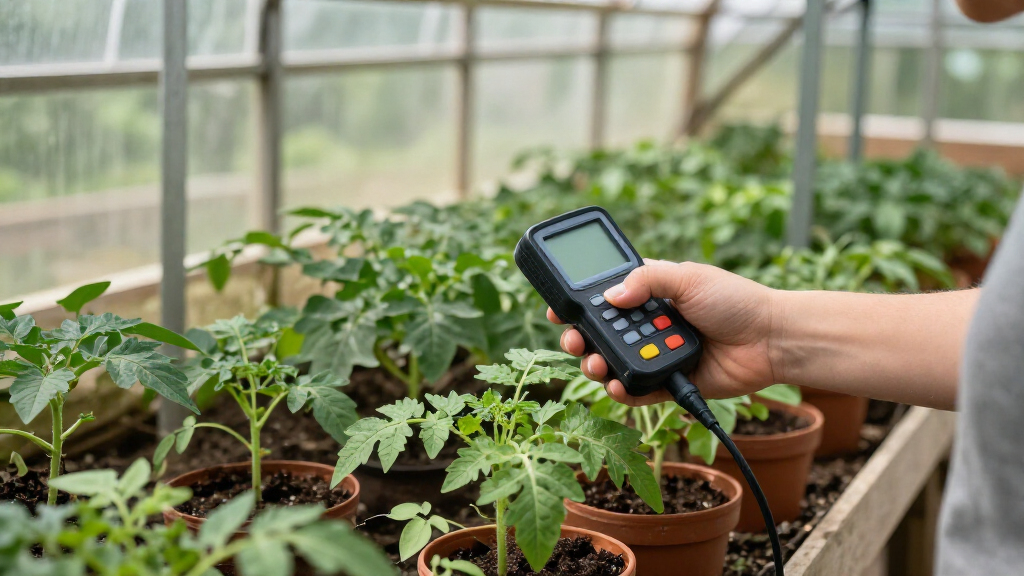
I compared these meters around the jobs growers actually need them to do: measure plant-relevant light, take repeatable readings across a canopy, and reach the spots where plants receive light. I gave weight to the stated measurement focus, sensor arrangement, handling, and whether added readings such as UVA or infrared serve a clear use case. A meter with extra functions did not automatically rank higher; those features matter only when they answer a buyer’s real measurement question.
The Apogee MQ-500 ranks first as the most focused option in this lineup for full-spectrum PAR measurement. Its AM-330 wand bundle follows for growers who need better access, while the Landtek earns a distinct role for buyers who want additional UVA and IR readings. The remaining options are differentiated by their stated band coverage and sensor design, but buyers should check the exact specifications and included accessories before choosing among similarly named meters. I ranked for fit and clarity of purpose, not for claims unsupported by the product descriptions.
| grow light meter | Model |
|---|---|
| Apogee MQ-500 Full-Spectrum Qu | — |
| DANOPLUS Quantum PAR Meter | DP-355 |
| Landtek 3-in-1 PAR Meter for P | MILA53000 |
| YOWEXA Digital Light Meter wit | — |
| AH-Quantuv PAR and UVA Meter f | AH-Quantuv |
| Apogee MQ-500 Full-Spectrum Qu | — |
| Quantum PAR Meter for LED Grow | PAR-355 |
Factors to Consider When Choosing Best Grow Light Meters
Choosing a grow light meter starts with the question you need it to answer. These broader checks can help avoid paying for readings you will not use—or buying a meter that cannot reach the measurement points that matter in your growing space.
Match the measurement to the decision
For comparing light across a canopy or adjusting fixture height, a PAR or PPFD-focused meter is usually the most relevant tool in this lineup. UVA and infrared readings address different questions, such as whether those bands are present, and do not replace a plant-light measurement. A common mistake is to treat a longer list of measured bands as proof of better grow-light guidance. Before buying, write down whether you need to set intensity, compare zones, or inspect additional wavelengths. Choose the meter whose stated output answers that question directly. If you are unsure, prioritize a clear PAR measurement over extras you may never consult.
Check what the meter measures across your actual fixture
Grow lights can differ in spectrum, and a meter’s response to that spectrum affects how useful its readings are. Look for explicit information about the meter’s measurement range and suitability for the LED or other fixture you own. A stated 400–700 nm range describes a band, but buyers should still confirm the manufacturer’s guidance for their light source. Avoid assuming that every meter labeled PAR performs identically across all fixtures. If you use several different light types, broader compatibility information may matter more than a single headline feature. When specifications are unclear, ask the seller or manufacturer before relying on the reading for repeated comparisons.
Plan how you will sample the canopy
A single reading at the center of a grow area can hide dim corners or intense spots directly beneath a fixture. For useful comparisons, measure a consistent set of points at plant height and keep the sensor orientation and distance consistent. A split sensor can help when the display and sensing head need to be positioned separately, while a telescopic wand can reduce awkward reaching. These conveniences matter most with dense foliage, shelves, or fixtures mounted over a large area. For an open, small growing space, a simpler handheld meter may be easier to store and use. Think about your room layout before treating portability as a minor detail.
Decide whether extra wavelength readings earn their place
Additional UVA or infrared measurements can be useful if your lighting plan explicitly includes those bands and you have a reason to monitor them. They can also add complexity without improving routine intensity checks for growers focused on standard PAR readings. Do not assume a meter that reports an extra band can evaluate every aspect of plant response or fixture quality. Check what units and measurement limits apply to each function, then decide whether you will use the information regularly. If not, a dedicated PAR meter may offer a clearer workflow. Paying for functions you cannot interpret is a poor trade even when the feature list looks appealing.
Consider access, durability, and upkeep before paying more
A higher-end meter makes more sense when its measurement role, build, or accessories solve a recurring problem. For example, difficult access across a tall or crowded canopy can justify a wand-style setup; it is less compelling if you only take occasional readings at arm’s reach. Check whether the sensor is protected during storage and whether the maker provides guidance on calibration, care, or service. Keep the sensing surface clean and follow the manual’s instructions, since damage or contamination can undermine readings. Also verify what is included in a bundle rather than assuming accessories are standard. The right spend is the one that improves the accuracy and consistency of your routine, not merely the one with more components.
Frequently Asked Questions
Is the Apogee MQ-500 worth choosing over a less specialized meter?
It makes the most sense if your main task is measuring PAR and comparing light levels across plants or grow zones. Its focused role is the reason it ranks ahead of broader or less clearly differentiated options here. If you mainly want occasional checks and do not need a dedicated full-spectrum PAR tool, a simpler meter may be a better fit. Consider how often you will use the readings to adjust placement or intensity. Also confirm that the product’s measurement guidance matches your fixture and workflow before deciding.
Should I choose the MQ-500 with the AM-330 wand or the standard MQ-500?
The wand bundle is more useful when your sensor needs to reach over a canopy, onto shelving, or into awkward spots without moving plants. If you can comfortably place the standard sensor at each measurement point, the added reach may not justify the extra equipment. Both options share the MQ-500’s central measurement purpose, so this choice is mainly about access and handling. Think about where the sensor must sit, not just where the display is easiest to read. Check the bundle contents and compatibility before ordering.
Do I need UVA and infrared readings for ordinary grow-light adjustments?
Most routine comparisons of light intensity focus on PAR or PPFD, so extra UVA and infrared functions are not automatically necessary. They may suit a grower who deliberately monitors those bands as part of a specific lighting plan. The Landtek is the distinct option in this group for buyers who want that broader set of readings. Before paying for the added functions, confirm what each reading represents and how you will use it. If you cannot name a decision the extra data will inform, a focused PAR meter is likely the simpler choice.
Can a meter labeled 400–700 nm give me all the information I need about an LED grow light?
That range identifies the band the meter is designed to measure, but it does not by itself describe every feature of a grow light or guarantee that the meter suits every fixture. Check the manufacturer’s stated compatibility, measurement units, and any guidance for LED sources. A PAR reading can help compare intensity at plant level, but it does not replace a full assessment of spectrum or canopy coverage. Take readings at multiple consistent points rather than treating one measurement as a verdict on the whole space. For unusual fixtures, confirm meter suitability before relying on the numbers.
What should I prioritize if I am new to measuring grow lights?
Start with a meter whose main output is easy to interpret and whose sensor you can place reliably at plant height. A dedicated PAR option is often less confusing than a device with several readings you do not yet need. Make a simple map of your growing area and take readings at repeatable points, keeping height and orientation consistent. Do not assume one center reading represents the whole canopy. If your setup is cramped, sensor access may matter more than a larger feature set, so compare the YOWEXA split sensor or a wand-equipped option against your layout.
Conclusion
For the clearest dedicated PAR focus, I recommend the Apogee MQ-500 as best overall. The DANOPLUS Quantum PAR Meter is my best-value direction for buyers who want a straightforward 400–700 nm tool, while the MQ-500 with AM-330 wand is the best premium fit for hard-to-reach measurement points. Beginners should favor a simple meter they can place consistently, with DANOPLUS a more approachable starting point than a multi-function device. For specific needs, choose the Landtek if UVA and infrared readings matter, or the YOWEXA if a split sensor better suits a tight growing space. Compare the exact specifications and included accessories before choosing between similarly named Quantum PAR models.